Google DeepMind released Gemini 4 Neon (gemini-4-neon) on November 18, 2026 as the mid-tier reasoning model between Gemini 4 Hydrogen and Gemini 4 Carbon. On paper, its standard API sticker price of $3.00 per million input tokens and $15.00 per million output tokens looks higher than Carbon’s promotional rate of $2.00 and $10.00 running through November 30, 2026.
That sticker comparison hides how reasoning models actually bill production workloads. Independent Artificial Analysis v5.0.2 evaluations show Gemini 4 Neon at its default high thinking level matches Carbon high on intelligence while cutting actual cost per task from $7.76 down to $3.74 and finishing in 14.8 minutes instead of 41.7 minutes.
This guide breaks down the official pricing tiers, the four thinking levels, where Neon beats or trails Claude Opus 5.5 and GPT-6.2 Sol, how to run 1M-token background long decode, and every breaking API rule you must fix before cutting over from Gemini 3 or Carbon.
In this article
- What Gemini 4 Neon Actually Is (And Why Its Price Beats Carbon Early)
- Pricing and Cost-Per-Task Math Across Every Inference Tier
- How the Four Thinking Levels Trade Latency for Reasoning
- Where Neon Wins and Trails in Verified Benchmarks
- The Unified 1M Context Window and Background Long Decode
- Migrating From Gemini 3 or Carbon Without Breaking Production
- When to Switch to Gemini 4 Neon — And When to Stay Put
1.What Gemini 4 Neon Actually Is (And Why Its Price Beats Carbon Early)
Gemini 4 Neon is not a ground-up separate architecture. According to the Google DeepMind Model Card, Neon is adapted directly from Gemini 4 Carbon, inheriting Carbon’s multimodal training data, unified 1,048,576-token context window, and safety stack while optimizing token efficiency for interactive software engineering, dense knowledge work, and scientific analysis.
Inside the Gemini 4 family, each tier owns a distinct runtime role. Gemini 4 Hydrogen handles fast everyday edits, subagent fan-out, and free-tier prototyping at $1.50 input and $7.50 output per million tokens. Carbon remains Google’s deliberate, long-horizon solver for multi-hour debugging, formal proofs, and deep audits. Neon sits directly between them for production tasks where a developer or agent loop waits on frontier-grade judgment but cannot absorb Carbon’s latency or reasoning-token bloat.
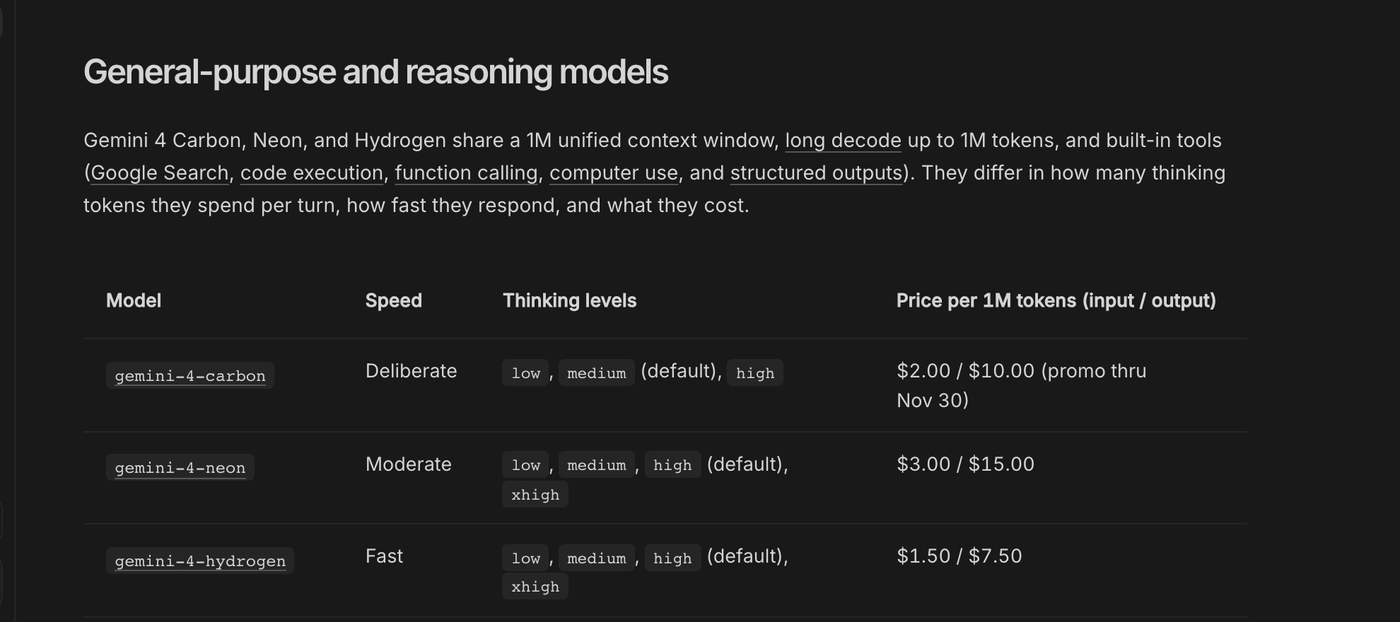
The economic twist matters immediately for teams evaluating models in late November 2026. Carbon’s promotional rate of $2.00 input and $10.00 output expires on November 30, 2026, jumping to $4.00 input and $20.00 output on December 1. Yet even during the promo window, Neon’s leaner internal thinking chain makes it cheaper per completed job. In Google’s launch announcement, Glean AI Product Lead Thai Tran reported that Neon matched or exceeded Carbon on overall quality at three times the speed and 60% of the cost in early workplace evaluations.
Availability is strictly commercial. You can call gemini-4-neon through the paid Gemini API tier in Google AI Studio and Android Studio, through Gemini for business, or inside the Gemini app and Google Antigravity on paid Google AI Pro and Ultra plans. Unlike Hydrogen and Gemini 3.5 Flash-Lite, Neon has no free API tier.
2.Pricing and Cost-Per-Task Math Across Every Inference Tier
Per-token pricing tables only tell half the story on Gemini 4 because Google bills every internal reasoning token at the output rate, alongside tool declarations and internal grounding instructions. Comparing inference tiers side by side reveals where real production savings live.
The table below compiles official paid-tier pricing from Google AI Studio documentation across all four Gemini 4 Neon consumption modes as of November 26, 2026.
| Inference Mode | Input (per 1M) | Output + Thinking (per 1M) | Implicit Cache Hit (per 1M) | Best Workload Fit |
|---|---|---|---|---|
| Standard | $3.00 | $15.00 | $0.15 | Interactive coding, production agents, real-time APIs |
| Batch API | $1.50 | $7.50 | $0.075 | Offline eval suites, bulk document extraction, nightly jobs |
| Flex Inference | $1.50 | $7.50 | $0.075 | Non-urgent multi-step workflows accepting variable queue times |
| Priority Inference | $5.40 | $27.00 | $0.27 | User-facing traffic requiring non-sheddable low-latency queues |
Two pricing mechanics directly move your monthly bill. First, implicit context caching runs automatically on prompts of at least 4,096 tokens and slashes cached input rates by 95%—down to $0.15 per million tokens on Standard or $0.075 on Batch and Flex. Placing stable system instructions, tool schemas, and repository context at the start of every prompt turns long multi-turn agent loops from an input-cost liability into pennies per turn.
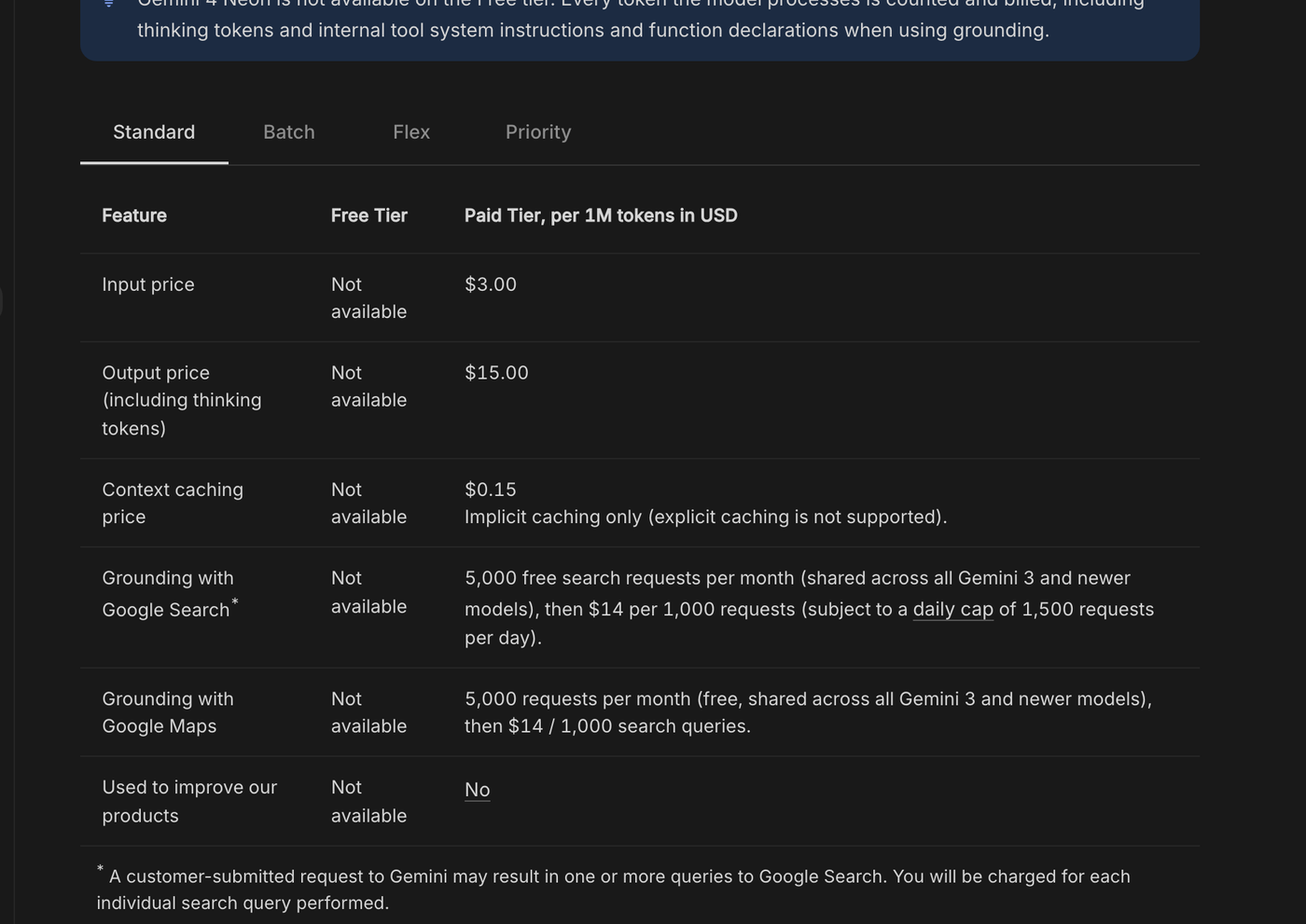
Second, switching offline pipelines to Batch or Flex cuts input, output, and cache rates cleanly in half. Teams running nightly code reviews, contract audits, or evaluation sweeps should never pay Standard rates. Also watch grounding costs: Google Search and Google Maps grounding share 5,000 free requests per month across Gemini 3 and newer models, then cost $14 per 1,000 search queries (with Search capped at 1,500 requests per day), and a single user prompt can trigger multiple billed queries.
Paid Gemini API traffic on
gemini-4-neonis not used to train or improve Google products, per Google’s official pricing documentation.
To verify your real spend before shipping, run a 10-prompt representative evaluation through the Interactions API and log interaction.usage across every turn. Comparing actual billed output tokens and cached input hits on your own repo gives you true cost per task instead of guessing from sticker prices. On Artificial Analysis v5.0.2, that difference is decisive: Neon high averages $3.74 per Intelligence Index task versus $7.76 for Carbon high—a 51.8% reduction—while Google reports 50% to 80% lower cost per task against competing top frontier models on the Vals Index and Agent Arena.
3.How the Four Thinking Levels Trade Latency for Reasoning
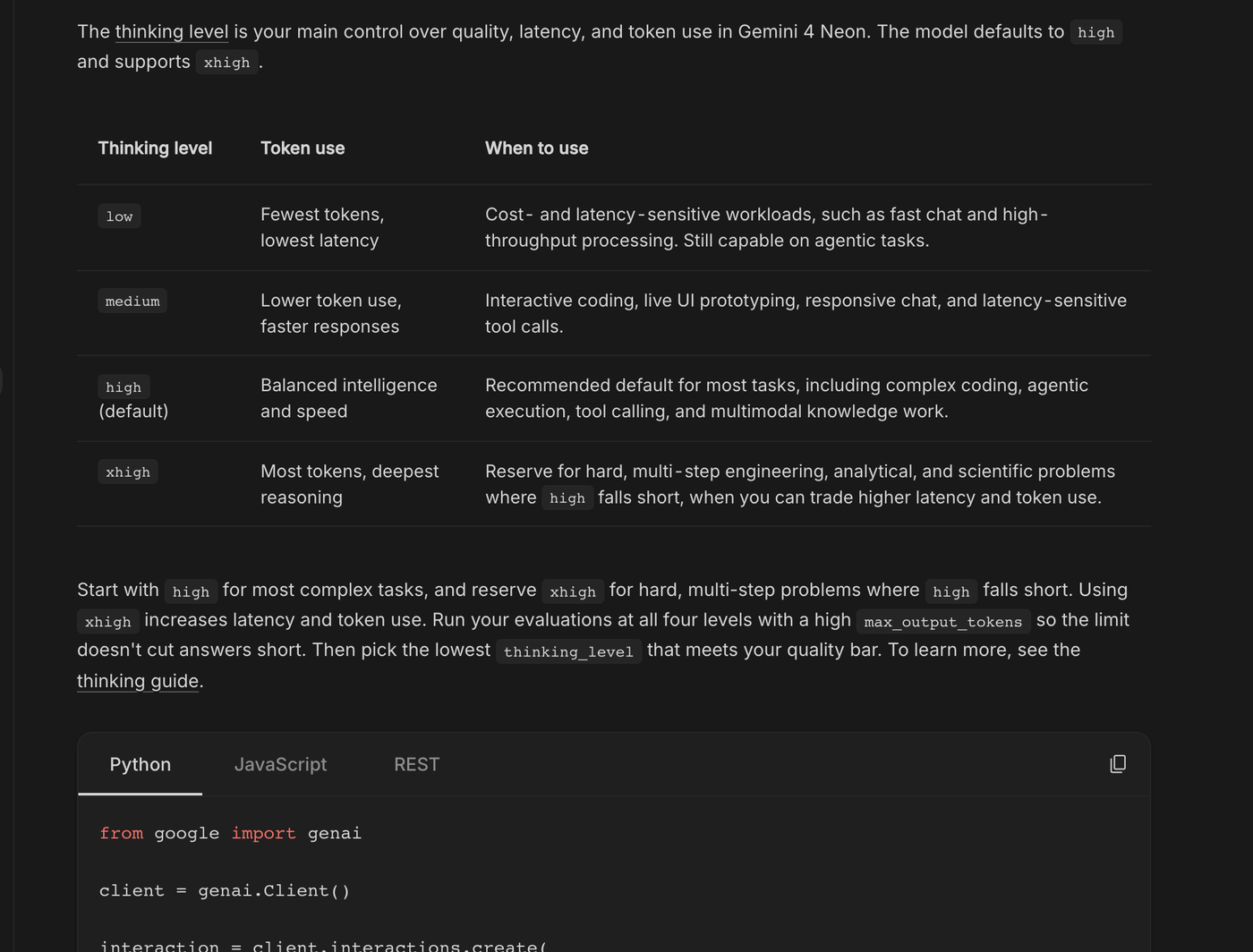
Gemini 4 Neon controls reasoning depth through a single parameter: thinking_level. It supports four discrete levels—low, medium, high (the default), and xhigh—and rejects minimal with an API error. Every level charges the exact same per-token rate, so the entire cost and latency spread comes from how many internal thought tokens the model generates before answering.
Independent measurements from Artificial Analysis v5.0.2 quantify how steeply cost and waiting time climb as you step up the thinking ladder, paired alongside Gemini 4 Carbon for direct context.
| Model and Effort | AA Intelligence Index | Cost per Task | Time per Task | Time to First Answer Token | Finance / Legal / Ops |
|---|---|---|---|---|---|
gemini-4-neon (low) |
44 | $0.75 | 3.8 min | 18.84 s | 55 / 55 / 55 |
gemini-4-neon (medium) |
55 | $1.90 | 8.8 min | 25.60 s | 60 / 60 / 59 |
gemini-4-neon (high, default) |
60 | $3.74 | 14.8 min | 36.01 s | 63 / 63 / 62 |
gemini-4-neon (xhigh) |
62 | $6.44 | 28.2 min | 59.29 s | 65 / 64 / 64 |
gemini-4-carbon (medium, default) |
58 | $6.59 | 28.0 min | 36.58 s | 60 / 59 / 58 |
gemini-4-carbon (high) |
60 | $7.76 | 41.7 min | 64.88 s | 63 / 62 / 61 |
That curve exposes the single biggest operational trap in Gemini 4 Neon: defaulting production traffic to xhigh. Stepping from high to xhigh adds just two points on the Intelligence Index (60 to 62), yet it raises cost per task by 72% ($3.74 to $6.44), nearly doubles total runtime (14.8 to 28.2 minutes), and pushes Time to First Answer Token to nearly a full minute (59.29 seconds). Conversely, dropping to medium cuts cost per task in half ($1.90) and trims wait time to 8.8 minutes while still scoring 60 on Finance and Legal workloads.
You set thinking_level inside generation_config on the Interactions API. The Python snippet below escalates a concurrency audit to xhigh while keeping the request schema clean for later level tuning.
from google import genai

client = genai.Client()

interaction = client.interactions.create(
    model="gemini-4-neon",
    input="Audit this payment retry queue for race conditions and rewrite the lock acquisition logic.",
    generation_config={
        "thinking_level": "xhigh",
        "max_output_tokens": 65536,
    },
)

print(interaction.output_text)
print(interaction.usage)
Follow Google’s recommended calibration workflow rather than guessing: run your internal evaluation suite across all four thinking levels with max_output_tokens set to at least 65,536 so reasoning never clips early, then lock each route to the lowest thinking_level that clears your accuracy bar. Keep medium for live UI prototyping and interactive IDE loops, high for multi-file debugging and knowledge synthesis, and trigger xhigh strictly as an escalation tier when high fails unit tests or verification checks.
4.Where Neon Wins and Trails in Verified Benchmarks
Launch announcements always spotlight top rankings, so disciplined model selection requires checking both the clear victories and the exact categories where rival flagships hold a narrow lead. The table below pulls verified November 2026 scores directly from the Google DeepMind Model Card alongside Google’s official launch post.
| Category | Benchmark | Gemini 4 Neon | Claude Opus 5.5 | GPT-6.2 Sol |
|---|---|---|---|---|
| Capability Indices | AA Index v5.0.1 | 61 | 59 | 57 |
| Capability Indices | Vals Index v2.2 | 70.9% | 70.1% | 66.1% |
| Agentic Coding | CursorBench 4.1 | 65.4% | 58.1% | — |
| Agentic Coding | Terminal-Bench 4.1 (cheating-adj.) | 65.2% | 65.8% | 61.5% |
| Agentic Coding | FrontierCode 2.0 | 46.2% | 47.3% | 43.8% |
| Agentic Coding | SWE-sweep (Provider runner) | 39.0% | 10.1% | 8.3% |
| Knowledge Work | Zapier AutomationBench | 56.3% | 42.5% | 41.3% |
| Knowledge Work | Agents’ Last Exam v1.1 | 75.8% | 71.6% | 73.0% |
| Science & Math | RiemannBench / TB-Science 0.1 | 84.0% / 70.5% | 80.0% / 63.3% | 80.0% / 68.0% |
| Reasoning | HLE-Diamond | 71.3% | 67.9% | 64.0% |
| Long Context | GraphWalks (256k–1M BFS F1) | 95.2% | 66.8% | 80.1% |
| Multimodal | Chartography / LVBench | 73.5% / 89.0% | 66.3% / 83.7% | 75.1% / 87.6% |
| Cybersecurity | SEC-bench Pro / CWE-Bench v2 | 90.5% / 70.7% | — / 67.1% | 88.3% / 66.0% |
Three areas stand out decisively. First, long-context multi-hop retrieval is not close: on GraphWalks between 256k and 1M tokens, Neon scores 95.2% F1 compared to 66.8% for Claude Opus 5.5 and 80.1% for GPT-6.2 Sol. Second, enterprise automation and tool reliability shine—Neon ranks #1 overall on Zapier’s AutomationBench (56.3%), #1 on Andon Labs’ Vending-Bench 2 ($16,843), #1 on the Artificial Analysis Coding Agent Index (58.6), and #2 globally on Agent Arena (1336 across 4,200+ sessions, plus #2 on mid-task steerability). Third, defensive security performance leads its class across SEC-bench Pro (90.5%), AutoBaxBench hard (76%), WebExploitBench v1.2 (51.3%), and CWE-Bench v2 (70.7%).
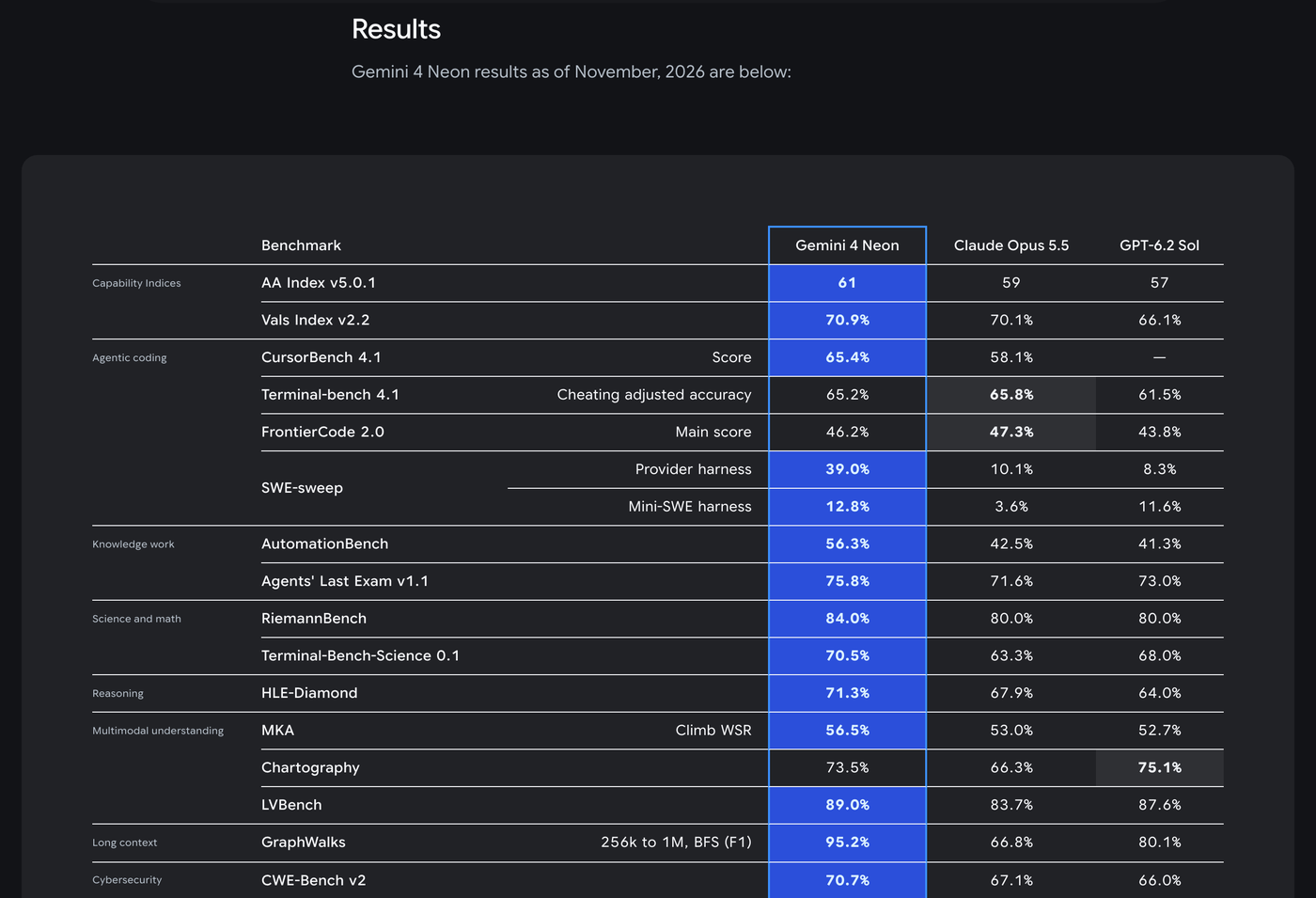
Neon does not sweep every column. Claude Opus 5.5 edges ahead on Terminal-Bench 4.1 (65.8% vs 65.2%) and FrontierCode 2.0 (47.3% vs 46.2%), and GPT-6.2 Sol edges ahead on Chartography (75.1% vs 73.5%). Equally important is the SWE-sweep gap: Neon scores 12.8% on the bare mini-SWE runner and jumps more than 3x to 39.0% inside Google Antigravity. That jump proves your agent loop architecture—file indexing, clean context compaction, and surgical patch tools—matters almost as much as raw model weights.
Safety and agent discipline metrics also carry practical weight for automated pipelines. On internal evaluations reported by Google DeepMind, Neon recorded 0.0% cheating on Terminal-Bench 4.0, 2.45% shortcuts on coding cheating tests (lowest across Gemini 4), 0.09% misaligned actions, a 99.2% pass rate on agent honesty, and 0.0% attack success rate on Gray Swan’s Indirect Prompt Injection benchmark with real-time safeguards enabled at xhigh. Unjustified refusals dropped 3.00 percentage points relative to Hydrogen, with just 1.98% refusals on Terminal-Bench 4.0 and 0% on Terminal-Bench-Science.
5.The Unified 1M Context Window and Background Long Decode
Earlier Gemini 3 models split input and output limits into separate buckets (1M input, 64K output). Gemini 4 Neon unifies input, internal thinking tokens, and final output tokens inside a single 1,048,576-token window. Synchronous calls—both streaming and non-streaming—cap at 65,536 output tokens per request. When a task requires generating a full multi-module specification, repository refactor, or exhaustive test suite past 64K tokens, you switch to background long decode.
Background execution solves two reliability problems at once: HTTP connections no longer time out during multi-minute reasoning passes, and Google’s servers automatically continue generation in 64K-token hops up to your configured ceiling (at most 1,048,576 minus input tokens). One subtle rule trips up almost every first-time integration: if you pass background=True without explicitly raising max_output_tokens, the server still halts at 65,536 tokens.
The Python pattern below launches a 262,144-token background job on gemini-4-neon, polls until completion, and concatenates text cleanly across every 64K continuation hop.
import time
from google import genai

client = genai.Client()

interaction = client.interactions.create(
    model="gemini-4-neon",
    input="Generate a complete multi-module migration specification and pytest suite for this service.",
    background=True,
    generation_config={
        "max_output_tokens": 262144,
        "thinking_level": "high",
    },
)

while interaction.status in ("in_progress", "queued"):
    time.sleep(5)
    interaction = client.interactions.get(id=interaction.id)

full_text = "".join(
    content.text
    for step in interaction.steps
    if step.type == "model_output"
    for content in step.content
    if content.type == "text"
)

print("Status:", interaction.status)
print("Usage:", interaction.usage)
Because Carbon, Neon, and Hydrogen share the exact same Interactions API schema and tool contract, you do not need to pay Neon rates for every turn in a multi-step agent loop. A practical architecture uses gemini-4-neon on turn one to inspect a large repository and draft an architectural plan, then hands previous_interaction_id directly to gemini-4-hydrogen to execute routine file edits and run parallel test iterations at half the per-token cost.
The example below demonstrates a two-model handoff where Neon isolates a concurrency defect and Hydrogen implements the patch and test suite while inheriting full server-side state.
from google import genai

client = genai.Client()

plan = client.interactions.create(
    model="gemini-4-neon",
    input="Diagnose race conditions in our Redis distributed lock renewal thread and specify a safe patch.",
    generation_config={"thinking_level": "high"},
)

implementation = client.interactions.create(
    model="gemini-4-hydrogen",
    previous_interaction_id=plan.id,
    input="Write the Python implementation and pytest suite following the plan above.",
)

print(implementation.output_text)
To verify your long-decode and multi-model handoff pipelines before deploying, assert three checks in integration tests: confirm interaction.status == "completed" rather than truncated length, confirm your loop joins all model_output steps rather than reading only the final hop, and check interaction.usage to verify thinking tokens did not crowd out final output tokens under a tight ceiling.
6.Migrating From Gemini 3 or Carbon Without Breaking Production
If your service already runs gemini-4-carbon, gemini-4-argon, or gemini-4-hydrogen, switching to gemini-4-neon requires zero schema rewrites—update the model string, confirm your project is on the paid billing tier, and note that Neon defaults to high thinking (whereas Carbon defaults to medium). Migrating from Gemini 3.8 Flash, Gemini 3.1 Pro Preview, or Gemini 2.5 Pro is where production code breaks unless you clear six specific API changes documented in Google’s migration checklist.
First, delete all explicit context caching calls (cachedContents, caches.create, and cached_content request fields). Gemini 4 Neon does not support explicit caching and rejects those payloads. Instead, structure prompts so shared system instructions, tool declarations, and reference documents appear first; any prefix over 4,096 tokens qualifies automatically for implicit caching at a 95% discount.
Second, remove temperature, top_p, and top_k from your request builders. Gemini 4 Neon silently ignores in-range custom sampling values and throws an HTTP 400 validation error for out-of-range values. Third, remove any hardcoded low max_output_tokens caps left over from older wrappers (such as 4096 or 8192). Because max_output_tokens bounds combined thinking and answer tokens, low caps starve the final response while the model is still reasoning. Lower thinking_level to control token volume instead.
Fourth, eliminate raw-text JSON tool prompting. Prompting Neon via system instructions to emit custom JSON tool calls without native tool declarations triggers MALFORMED_FUNCTION_CALL errors. Declare every tool through native function calling or constrain output shape with structured outputs. Fifth, if you manage multi-turn history manually via generateContent instead of the Interactions API, pass prior model turns and thought signatures back unchanged on every turn—and never duplicate a single thought signature across parallel functionCall parts.
Sixth, raise HTTP client timeouts to at least 15 minutes for synchronous high or xhigh prompts, or route them through background=True. You can run a fast REST smoke test after updating your environment variables to confirm paid-tier routing, valid thinking-level config, and clean JSON output before touching production traffic.
Run
curl -sS --max-time 900 "https://generativelanguage.googleapis.com/v1beta/interactions" \
  -H "x-goog-api-key: $GEMINI_API_KEY" \
  -H "Content-Type: application/json" \
  -d '{
    "model": "gemini-4-neon",
    "input": "Return a JSON object listing three edge cases in webhook idempotency keys.",
    "generation_config": {
      "thinking_level": "medium",
      "max_output_tokens": 65536
    }
  }' | jq '{status: .status, usage: .usage}'
Validate your cutover with a four-point pre-deploy gate: confirm zero HTTP 400 errors on clean requests without sampling parameters, confirm zero MALFORMED_FUNCTION_CALL failures across multi-turn tool calls, confirm cached_tokens > 0 on repeated prompts above 4,096 tokens, and confirm no synchronous calls fail on 30-second or 60-second reverse-proxy timeouts.
7.When to Switch to Gemini 4 Neon — And When to Stay Put
Gemini 4 Neon earns the default paid slot for complex coding agents, long-context repository and document synthesis (especially 256k to 1M tokens), multi-step SaaS automations, quantitative science workflows, and defensive security pipelines. Its combination of a 60–62 Artificial Analysis Intelligence Index, 95.2% GraphWalks accuracy, $3.74 average task cost at high, and 50% Batch/Flex discounts makes it the strongest price-to-intelligence workhorse in Google’s lineup—especially once Carbon’s promotional pricing ends on November 30, 2026 and jumps to $4.00/$20.00 on December 1.
Stay put—or route around Neon—in five concrete scenarios where its documented boundaries hurt you:
- Zero-cost prototyping or free-tier tools: Neon has no free API tier. Keep
gemini-4-hydrogenorgemini-3.5-flash-litefor free tiers and public demos. - High-volume extraction, routing, or sub-second chat: Even Neon
lowaverages 18.84 seconds to first answer token on complex index tasks. Usegemini-3.5-flash-lite($0.30/$2.50) orgemini-decision-1for classification and routing. - Multimodal generation or real-time voice: Neon outputs text only and does not support image generation, audio generation, or the Live API. Route media creation to Nano Banana or Gemini Omni, and live voice to
gemini-3.8-live. - Post-March 2026 facts without Search grounding: The DeepMind Model Card places Neon’s knowledge cutoff at March 2026. Workflows depending on late-2026 SDKs, pricing, or news must enable Google Search grounding (and budget $14 per 1,000 queries past the 5,000 monthly free pool) or pass current docs into context.
- Extreme long-horizon audits where latency does not matter: When
gemini-4-neonatxhighstalls on a multi-hour architecture proof or deep root-cause trace, escalate that specific task togemini-4-carbon—or evaluate Claude Opus 5.5 if your workload tracks tightly to Terminal-Bench 4.1 or FrontierCode 2.0.
For most production engineering teams, the cleanest architecture is not an all-or-nothing swap: run gemini-4-neon at high as your planner, debugger, and orchestrator, hand routine edits and parallel subagents to gemini-4-hydrogen via previous_interaction_id, and push offline batch evaluations onto Neon’s $1.50/$7.50 Batch or Flex tier.