Google announced Gemini 4 Carbon on October 28, 2026, just two weeks after Gemini 4 Argon reached developers. Google calls Carbon its strongest model so far, and an independent index ranks it first overall. Almost nobody can use it yet.
That gap between headlines and access is the most useful thing to understand about Carbon right now. The benchmark charts and demo videos are real, but the model is limited to a small group of cybersecurity teams, and Google has not given a date for anyone else.
This guide covers what Carbon is, who can use it and when, what the independent rankings and early demos show, what it will cost, and what to do while you wait. It draws on Google’s launch post, the Artificial Analysis and Arena rankings, and demos posted by early testers, as of November 3, 2026. We have not used Carbon ourselves.
In this article
1.What Gemini 4 Carbon Is
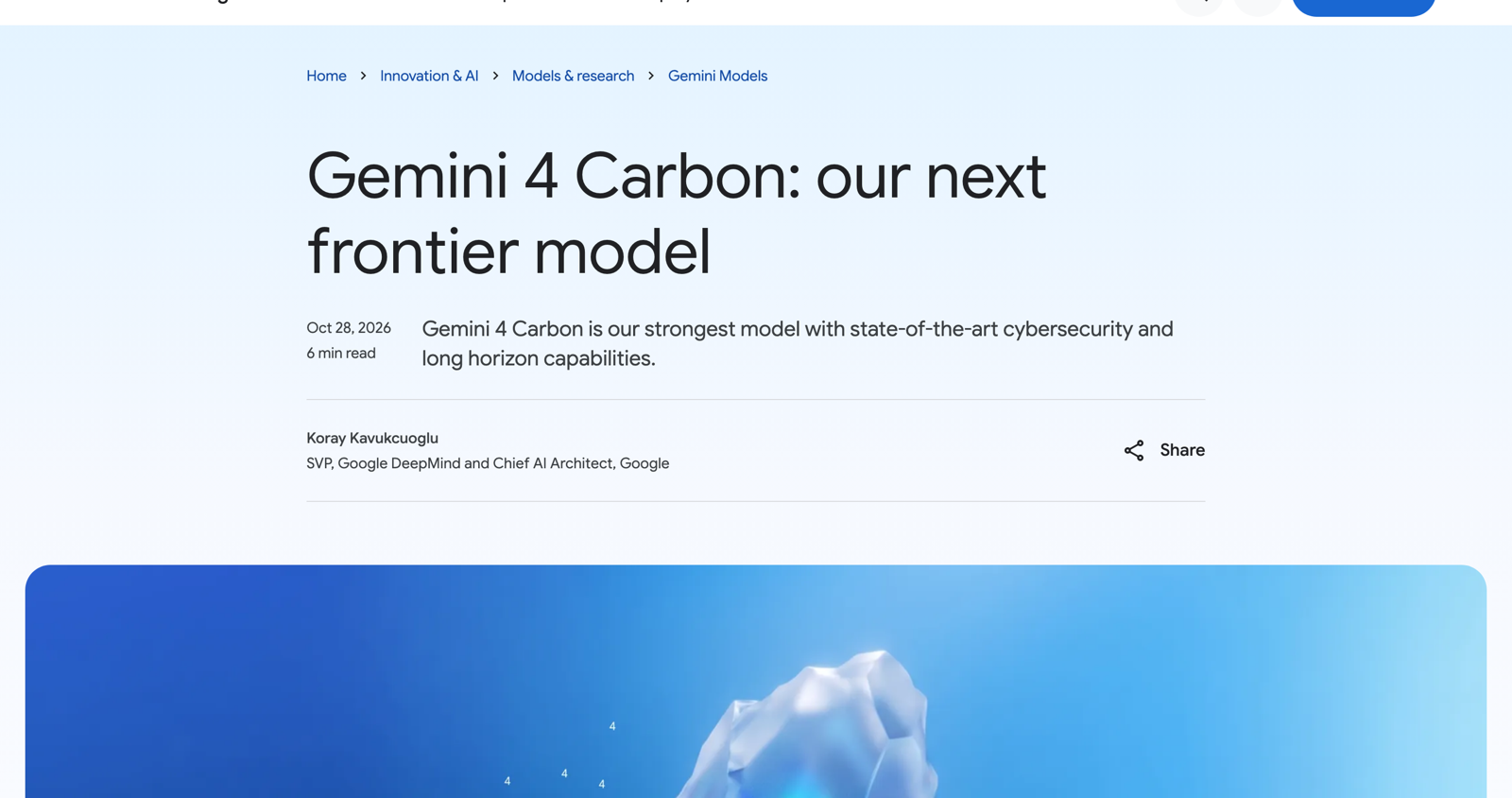
Gemini 4 Carbon is the second model in Google’s Gemini 4 family. Gemini 4 Argon, released first, is a reasoning model aimed at long, multi-step work; we covered it in our Gemini 4 Argon guide. Carbon sits above it, and Google’s launch post by Koray Kavukcuoglu describes it as Google’s next frontier model, with particular strength in cybersecurity and long-horizon work.
Google highlights three areas where Carbon moves beyond Argon:
- Cybersecurity. Tested without guardrails, Carbon scored 88.2% on SEC-bench Pro, which measures finding vulnerabilities, and 54.8% on ExploitGym, which measures exploiting and validating them. Google says it more than doubles Argon’s success rate at writing secure code, and that Chrome’s security team found its patches far better than those from another lab’s frontier model.
- Long tasks. Inside Google, Carbon has run for days on multi-step engineering work, such as tracing a subtle bug to its root cause across a large codebase, pushing through dead ends instead of stopping.
- Behavior. Google reports about half as many unsupported claims as Argon, fewer cases of the model doing more or less than asked, and a 0.0% success rate for prompt injection attacks on the Gray Swan benchmark, down from 0.7% for Argon.
That focus explains the unusual rollout. A model that is very good at finding and exploiting vulnerabilities is useful to defenders and attackers alike, so Google is releasing it to defenders first.
If you can describe Carbon as Argon’s more capable sibling, strongest at security and long engineering tasks, and not yet generally available, you have the right picture.
2.Who Can Use It, and When
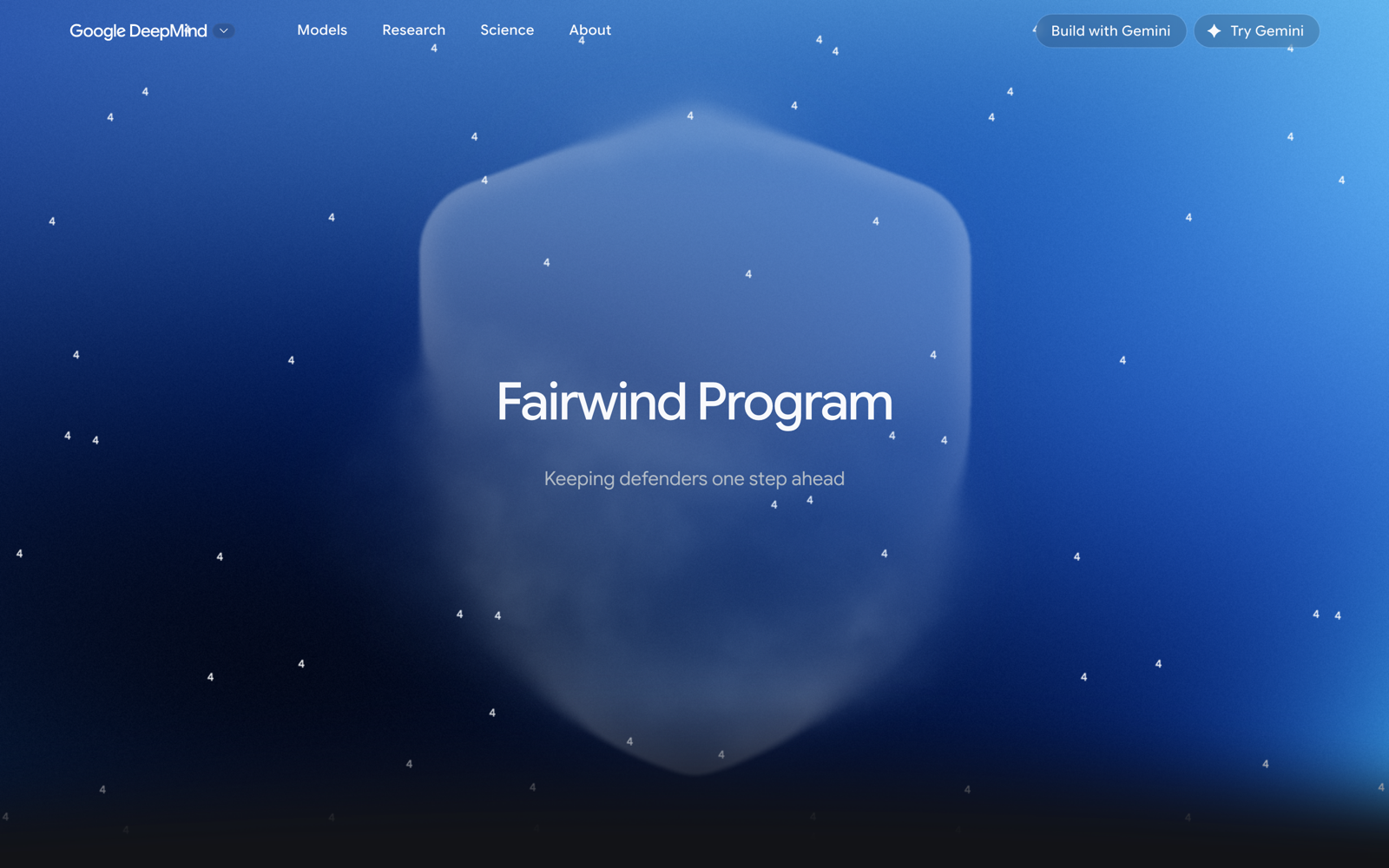
For now, access depends on who you are. Google says Carbon became available in launch week to a subset of cyber defenders, and that access will widen gradually to more trusted partners through its Fairwind Program, the same vetted-access program Google used for Argon’s first weeks.
The rollout so far runs in stages:
- Now: selected cybersecurity organizations in the Fairwind Program.
- Next: additional trusted partners, added gradually through Fairwind.
- Later: developers, businesses and consumers, which Google says it wants to do as soon as possible, once it has gathered feedback and refined its guardrails. There is no date.
Google also says it is taking part in the US government’s voluntary pre-release testing process for the model. Carbon is not in the Gemini app, Google AI Studio or the public Gemini API, so there is no model ID to call yet.
If you work in security for an organization that could qualify, the Fairwind page is the place to start, and an existing Google Cloud account team can help. Everyone else should plan on Argon. It is available now through the paid Gemini API and to Google AI Pro and Ultra subscribers, and Google has priced it the same as Carbon’s introductory rate, which makes switching later straightforward.
You know your route when you can answer one question: do you qualify for Fairwind? If not, your Carbon date is Google’s public release, and Argon is your model until then.
3.What the Rankings Say
Carbon’s launch headline is its first place on the Artificial Analysis Intelligence Index v5.0, with a score of 59. That number is real, but an index is an average, and the detail underneath it is more useful than the rank.
Three sources rank Carbon, and each measures something different. This table summarizes what each one reported at launch.
| Source | What it measures | Carbon’s result |
|---|---|---|
| Its own and third-party benchmarks | #1 on the Artificial Analysis index; #4 on WebDev Arena at 1768 Elo | |
| Artificial Analysis | An index of nine independent evaluations | 59 overall, first in 4 of the 9; second to Claude Opus 5.5 on its Coding Agent Index |
| Arena | Human votes on blind comparisons | #1 in Text, #2 in Agent, #4 in WebDev; median cost of $1.80 per task |
Artificial Analysis added two caveats in its launch post that are easy to miss. Carbon was not yet publicly available when it was tested, and its cost charts use the standard price, not the 50% introductory discount.
Google’s Gemini 4 Carbon is the new #1 on the Artificial Analysis Intelligence Index v5, and second only to Claude Opus 5.5 on the Artificial Analysis Coding Agent Index
Gemini 4 Carbon scores 59 on Intelligence Index v5, driven by leading performance in complex reasoning,… pic.twitter.com/gSH65FSKzL
— Artificial Analysis (@ArtificialAnlys) October 28, 2026
Arena’s cost figure is the most practical number here. It reported a median of $1.80 per task for Carbon, 72% less than Claude Opus 5.5 in its Max configuration. Coming from a ranking based on human preference votes, that suggests Carbon offers strong quality per dollar, not only strong quality.
Put together, the rankings say Carbon is among the very best models, cheaper per task than its closest rival, and not ahead everywhere. If your main use is autonomous coding agents, the Artificial Analysis result puts Claude Opus 5.5 slightly ahead on that index.
4.What Early Demos Show
Since the model isn’t public, most of what people have actually seen comes from testers with early access, many working through Arena’s model comparisons. Their posts are single prompts, not benchmarks, but together they show a pattern worth knowing about.
The strongest theme is 3D and visual work. The most widely shared demo, from @Mr_Salio, ran the same 3D build on Carbon and Claude Opus 5.5 side by side, and the tester judged Carbon much better at 3D.
🚨 Gemini 4 Carbon vs Opus 5.5
Carbon is SERIOUSLY good at 3D I don't think their is a model better than carbon at 3d, Overall this model deserves The top
this is just the Arena one Imagine what the official version will be capable of
Google is cooking pic.twitter.com/tIpqv0Shfn
— Salio (@Mr_Salio) October 28, 2026
A second tester, @chetaslua, built a three.js scene with animated characters from one prompt and was impressed by its completeness. They also noted a trade-off: Carbon sometimes thinks for 8 to 10 minutes before it answers. That fits Google’s emphasis on long tasks, but it changes how you use the model for quick back-and-forth work.
The demo with the most practical numbers came from @0xRhinoX, who gave both models the same prompt for an interactive rainbow jelly you can cut, nail and set on fire. They reported $4.30 and 32 minutes for Carbon against $14.00 and 1 hour 20 minutes for Opus 5.5.
Gemini 4 Carbon just DESTROYED Opus 5.5. For $4.30
Same prompt: rainbow jelly you can cut, nail and torch.
Gemini 4 Carbon – $4.30, 32 min
Opus 5.5 – $14.00, 1h 20mCarbon's jelly is bright, sharp and throws rainbow shadows across the table.
Opus looks washed out next to it.… pic.twitter.com/PUYuduQxNh— Rhino (@0xRhinoX) October 29, 2026
Another tester ran the same animation prompt, a convertible driving into a sunset, on Carbon and on Argon, and judged Carbon clearly ahead. Arena also published a 47-minute hands-on by Peter Gostev, testing Carbon against Argon, Opus 5.5, GPT-6.1 and others on 3D builds, visual explainers, interface tasks and a playable game. It is the most complete look at the model available.
Read these demos as evidence of where Carbon is strong, not as proof it wins every task. Each is one prompt, run once, judged by one person. The pattern across them, strong visual and 3D output at a lower cost per run with long thinking times, is what to carry forward.
5.What It Will Cost
Google published Carbon’s prices at launch, even though it isn’t on sale to the public yet. The structure matches Argon’s: an introductory rate, then a doubled standard rate, with no date given for the switch.
These are the prices from Google’s launch post, per million tokens.
| Per 1 million tokens | Introductory | Standard |
|---|---|---|
| Input | $2.00 | $4.00 |
| Output | $10.00 | $20.00 |
| Cached input | 95% off the input price | 95% off the input price |
As with Argon, the output price is the one to watch, because a reasoning model’s thinking is usually billed as output. A model that thinks for ten minutes before answering produces a lot of output tokens you never see.
Here is a worked example. Suppose a request sends 50,000 tokens of code and instructions, and Carbon uses 20,000 output tokens on thinking and its answer:
- Introductory: 50,000 input tokens at $2 per million is $0.10, plus 20,000 output tokens at $10 per million is $0.20, for $0.30 in total.
- Standard: the same request costs $0.60.
- If most of the 50,000 input tokens are a repeated, cached prefix, such as the same codebase context sent with every request, the input part falls by up to 95%.
Per token, Carbon costs the same as Argon at their introductory rates. The difference in your bill will come from how many tokens each model uses for the same job, which is exactly what the cost demos above try to measure.
To budget, price your typical request at both rates, add a generous allowance for thinking, and plan on the standard rate, since that is what you will pay once the introductory period ends.
6.How to Prepare Before It Opens
Most readers can’t use Carbon yet, but a few steps now will make switching quick when it opens, and will tell you whether it is worth switching at all.
- Build your own test set. Collect five to ten real tasks from your work where you know what a good result looks like, from simple to hard. This is the only benchmark that matters for your decision.
- Run it on Argon today. Argon is available now at the same introductory price. Its results give you a baseline, and much of your setup will carry over.
- Keep the model name configurable. If you call Gemini from code, keep the model ID in one setting rather than scattered through your project, so switching is a one-line change.
- Record cost and time, not just quality. Note the tokens and minutes each task takes. Carbon’s long thinking times may matter as much as its scores.
- Watch the official channels. Google’s blog and the Gemini API model list are where availability will be announced. Ignore third-party sites offering early Carbon access.
The decision then depends on your work:
- Wait for Carbon if you do security work, long autonomous engineering tasks, or 3D and visual builds, where its early strengths are clearest.
- Stay on Argon for most other reasoning work until your own tests show a real difference, since the price per token is the same.
- Compare with Claude Opus 5.5 if coding agents are your main use, where independent results put the two close, with Opus slightly ahead.
You’ll be ready when your test set runs on Argon with recorded costs, and switching the model name is the only change needed to run it on Carbon the day it opens.