Google’s first Gemini 4 model is now out of its testing phase. Gemini 4 Argon was announced on September 30, 2026, went first to a small group of security partners, and on October 13 opened to paying developers and to Google AI Pro and Ultra subscribers in the Gemini app.
Google describes it as its new flagship for long, multi-step work: large software projects, research, and document-heavy tasks in fields like finance and law. It also costs nearly three times as much per token as Gemini 3.8 Flash, the model most people use day to day, and more than five times as much from December.
This guide covers what changed, where you can use Argon today, what it costs, how to call it from code, and whether it is worth switching. The facts come from Google’s own announcement, developer documentation and pricing pages as of October 15, 2026. We have not run our own tests on it, so performance figures here are Google’s or its partners’.
In this article
1.What Gemini 4 Argon Is
Gemini 4 Argon is a reasoning model. Like other recent models, it “thinks” before answering, spending extra tokens to plan and check its work, and you can control how much. Google positions it above Gemini 3.8 Flash, its fast general model, and as the successor to Gemini 3.1 Pro for the hardest tasks.
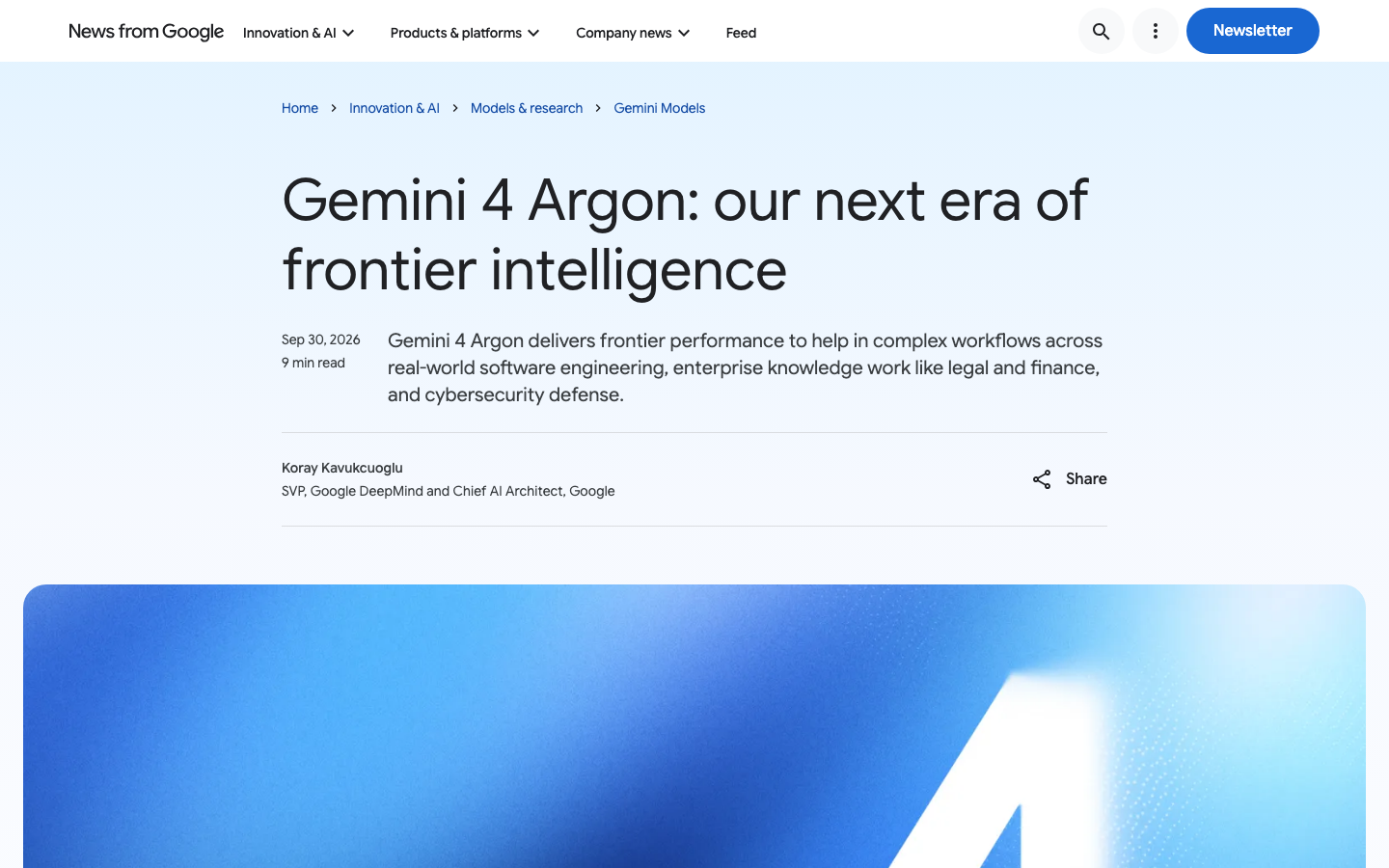
The rollout came in three steps. On September 30 Google announced it and gave access to vetted cybersecurity defenders through a limited program it calls Fairwind. Enterprise customers on Google Cloud followed. On October 13 it reached developers using the paid Gemini API and subscribers in the Gemini app.
Three changes matter more than the version number:
- Much longer answers. A single response can now run to 1 million tokens, up from 64,000 on earlier models. That counts the model’s thinking as well as its final answer. For most people this is invisible. It matters for work like migrating a whole codebase or writing a long technical report in one pass.
- A large shared budget. The model’s limit of 1,048,576 tokens covers input and output together. A very long document leaves less room for the answer.
- Built for long tasks. Google says it trained Argon to keep track of progress over many steps and to report problems instead of quietly giving up. Its announcement describes internal teams using groups of Argon agents to migrate C and C++ code to Rust and to find memory savings across Google’s data centers.
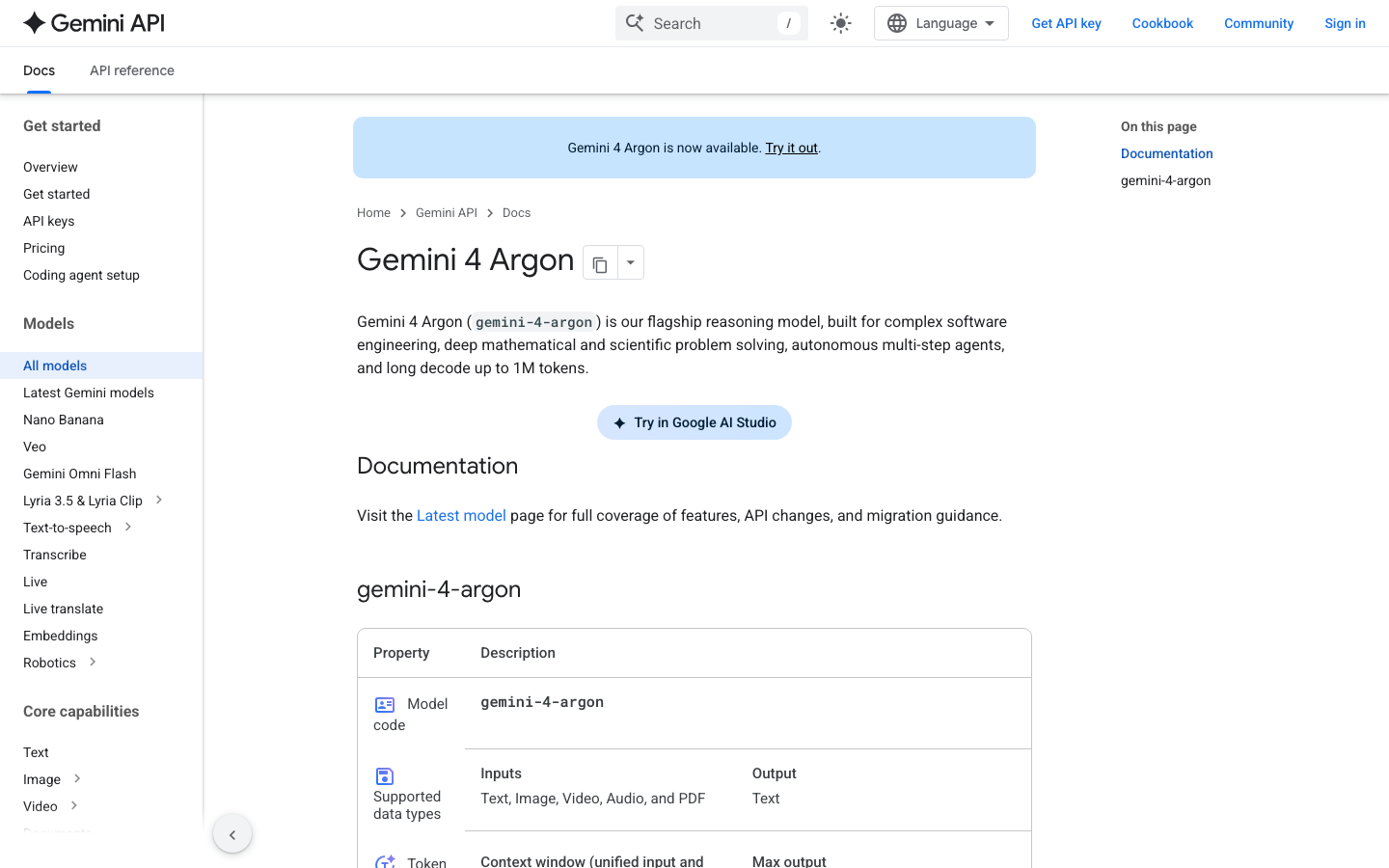
The model reads text, images, video, audio and PDFs, and writes text. It does not generate images or audio, and it does not support Google’s real-time voice API.
If you can explain Argon as “Google’s top reasoning model, aimed at long and difficult tasks, priced as a premium option,” you have the right picture.
2.Where You Can Use It Today
Argon is available in four places, and which ones you can use depends on the plan you already pay for. The free Gemini API tier is not one of them.
The table shows each route as of October 15, 2026, combining Google’s announcements with its pricing page.
| Where | Who can use it | What it is good for |
|---|---|---|
| Gemini app (web, mobile, macOS) | Google AI Pro and AI Ultra subscribers | Chat, research, documents, and the new tasks mode |
| Google AI Studio | Paid API users; AI Ultra subscribers can also try it | Testing prompts before building |
| Google Antigravity (agentic coding) | AI Ultra subscribers; also via the paid API | Multi-file coding work |
| Gemini API and Google Cloud | Paid tier only, model ID gemini-4-argon |
Building it into your own product or workflow |
In the Gemini app, it appears in the model picker as “4 Argon.” Google says the rollout is staged, so it may take a few days to appear on your account. Argon also comes with two app changes launched the same day: a switch between chat and tasks, where Gemini works in the background on a job you give it, and connections to more than 40 apps such as Instacart, OpenTable, Adobe and Shopify.
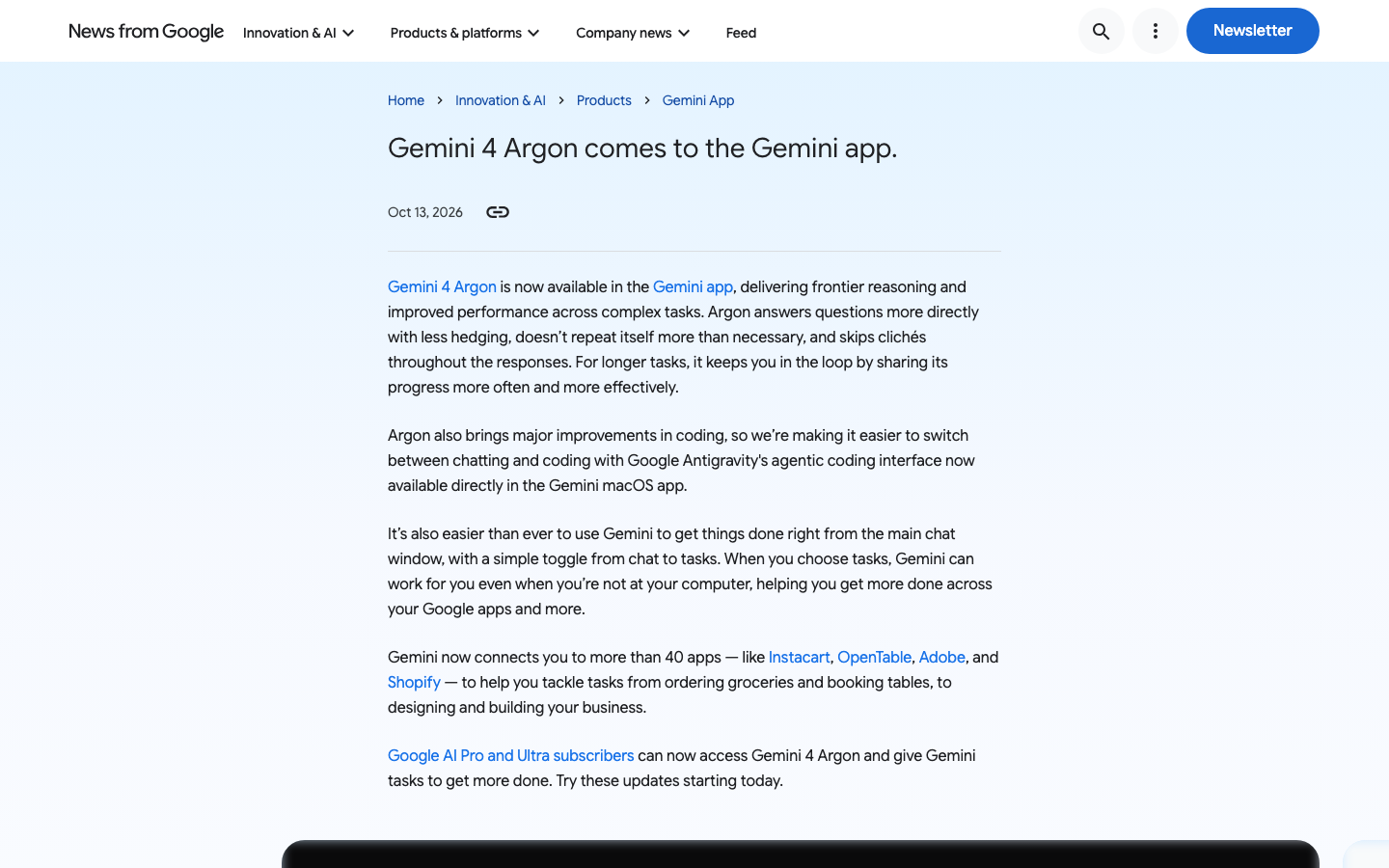
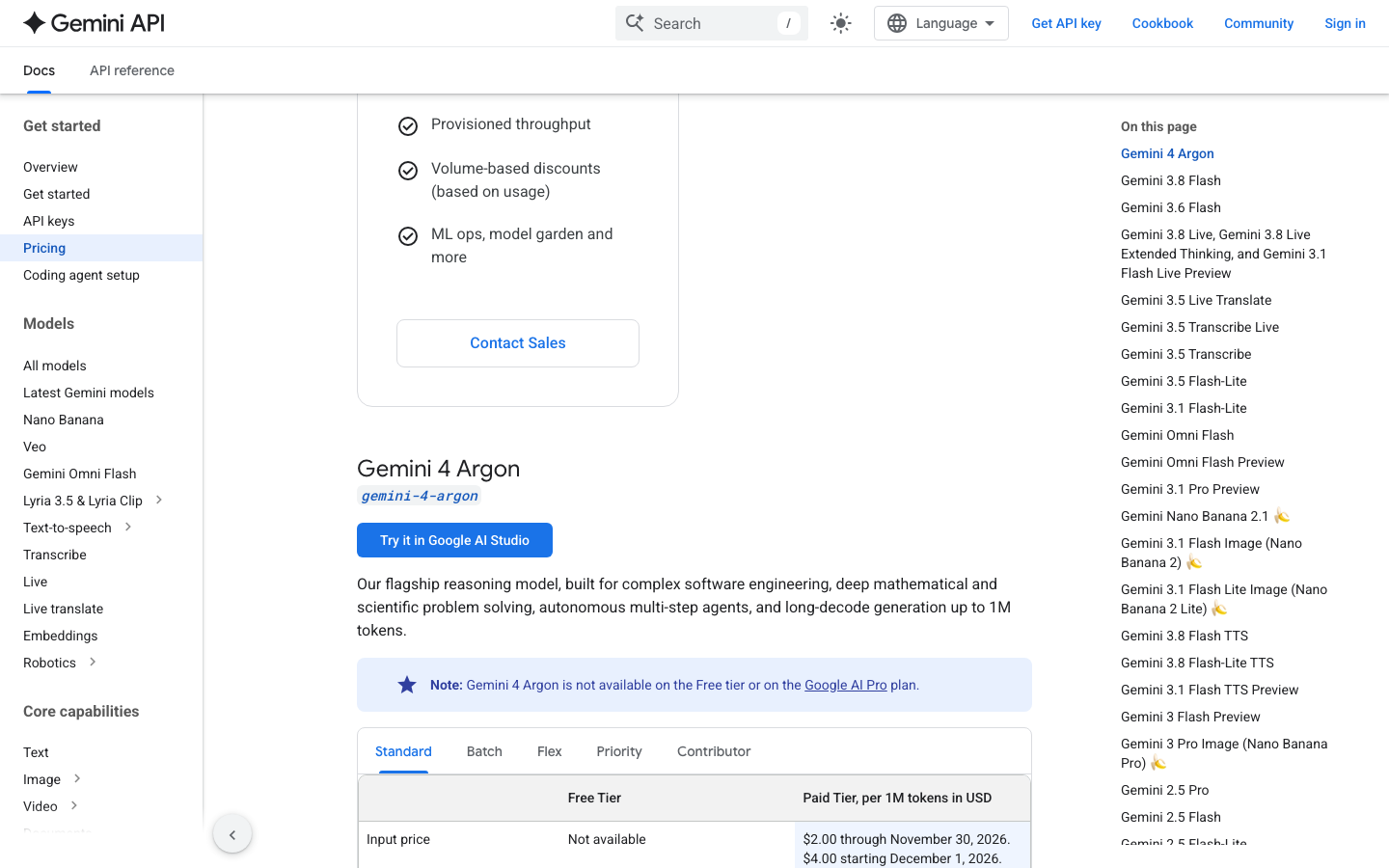
One detail catches people out. A Google AI Pro subscription gives you Argon in the Gemini app, but not free use in AI Studio or Antigravity. Google’s API pricing page states that Argon is not available on the free tier or on the AI Pro plan. Developers on AI Pro need to switch on paid API billing to call it from code.
To check your route, start from what you pay for. On AI Pro or Ultra, open the Gemini app and look for “4 Argon” in the model menu. If you build with the API, confirm that your Google AI Studio project has billing enabled.
3.What It Costs
Argon is priced per million tokens, with an introductory rate that doubles on December 1. These are Google’s published paid-tier prices for the Gemini API.
| Per 1 million tokens | Until November 30, 2026 | From December 1, 2026 |
|---|---|---|
| Input | $2.00 | $4.00 |
| Output, including thinking | $10.00 | $20.00 |
| Cached input | $0.10 | $0.20 |
| Search or Maps grounding | 5,000 requests a month free, then $14 per 1,000 | Same |
The phrase “including thinking” is the one to notice. The tokens the model spends reasoning are billed as output, at the higher rate, even though you never see most of them. A harder question gets more thinking and costs more, even if the final answer is short.
Here is a worked example. Suppose you send a 50,000-token document, about 35,000 words, and ask for an analysis. The model uses 15,000 tokens thinking and writes a 5,000-token answer, so 20,000 output tokens in total.
- Input: 50,000 tokens at $2 per million is $0.10.
- Output: 20,000 tokens at $10 per million is $0.20.
- Total: $0.30 per request now, and $0.60 from December 1.
The same request on Gemini 3.8 Flash, at $0.75 and $3.75 per million, would cost about $0.11, and Flash also has a free tier. So Argon costs about 2.7 times as much per token today and 5.3 times as much from December, and the gap per request grows when it thinks longer than Flash would.
Two features bring the cost down. Caching is automatic: when many requests share the same opening text of at least 6,144 tokens, such as long instructions or a reference document, that part is billed at the cached rate. Google’s pricing page also lists Batch and Flex options for work that does not need an instant answer; check their rates there before running large jobs.
To price your own use, take a typical request, estimate its input and output tokens, add a generous allowance for thinking, and multiply by the rates above. Then double it, because that is what the same work will cost in December.
4.Call It From the API
If you build with the Gemini API, Argon works through the same SDK, documented on its model page, as earlier models, with a few new rules that make older code fail. Start by upgrading the Python SDK: Google’s guide lists version 2.30.1 or later.
Install
pip install -U google-genaiA minimal call needs only the model name. The thinking_level setting controls how much the model reasons: LOW, MEDIUM (the default) or HIGH. Google recommends HIGH for multi-file code changes, proofs and architecture design, and MEDIUM for general coding, tool use and questions about documents.
from google import genai
from google.genai import types

client = genai.Client()  # reads GEMINI_API_KEY from the environment

response = client.models.generate_content(
    model="gemini-4-argon",
    contents="Review this function for bugs and explain each one: ...",
    config=types.GenerateContentConfig(
        thinking_config=types.ThinkingConfig(thinking_level="MEDIUM"),
    ),
)
print(response.text)
Two older settings now cause errors. Setting a thinking_budget, a token count used by earlier models, returns an HTTP 400 error, and so does the MINIMAL thinking level. If you are moving code from Gemini 3, remove both.
Long answers need one more step. By default a single request stops at 65,536 output tokens. To go further, stream the response and raise max_output_tokens, and the SDK continues the generation across requests for you:
config = types.GenerateContentConfig(
    max_output_tokens=256000,
    thinking_config=types.ThinkingConfig(thinking_level="HIGH"),
)
for chunk in client.models.generate_content_stream(
    model="gemini-4-argon", contents="Write a full migration plan for ...", config=config
):
    print(chunk.text or "", end="")
Google’s guide adds a caution: long decode gives the model more room to reason, but it does not make answers longer. Use it for problems that need extended reasoning, such as hard maths or a large codebase change. For an ordinary question it only adds cost.
You will know the setup works when a first call with MEDIUM returns text and your billing page shows the request against gemini-4-argon.
5.What It Is Good At, and What to Verify
Google’s announcement leads with four strengths. Each one comes with evidence, but almost all of that evidence is published by Google or by companies it partners with. That does not make it wrong, but it does mean you should test before relying on it.
Long software engineering tasks. Google reports a score of 77.9% on DeepSWE v1.1, a benchmark of long, real-world coding tasks, which it calls a new state of the art. Its own examples are larger than benchmarks: Google says Argon agents rewrote a video decoder’s Rust code to run 2.7 times faster, and that teams using it in Antigravity submitted 35% more agent-written code while rolling back nearly a third fewer changes.
Document-heavy knowledge work. Google says Argon leads the Vals Index, which scores finance, coding, legal and tax work, and partner quotes from legal and enterprise software companies describe better accuracy on long documents. For a marketer or analyst, this is the strength most likely to matter: turning long reports, transcripts or spreadsheets into one grounded summary.
Video and visual understanding. Google reports 91.7% on LVBench, a long-video benchmark, and describes chart analysis across many documents.
Resistance to manipulation. Prompt injection is when hidden instructions in a web page or document hijack an AI agent. Google says Argon leads a public benchmark for this, with attacks succeeding 0.7% of the time across 15 attempts. That matters most if you plan to let it read email or browse on your behalf.
Some limits come with the strengths. Argon does not generate images or audio. In general availability, its cybersecurity mode blocks offensive tasks such as penetration testing; the version without those guardrails is limited to vetted defenders. And Google’s consumer usage limits for the Gemini app are not published, so heavy use on a Pro plan may hit a ceiling you cannot see in advance.
Pick one claim that matches your work and test it on a real task you have done before, where you already know what a good result looks like. That single comparison will tell you more than any benchmark.
6.Should You Switch to It
For most people the answer is “for some tasks, not all of them.” Argon’s strengths are real, but it costs nearly three times as much per token as Gemini 3.8 Flash, rising to over five times in December, and much of everyday AI work does not need it.
The decision is easiest by type of work:
- Use Argon for long, hard tasks where a mistake is expensive: a large code change, analysis across many long documents, a research question that needs careful reasoning, or an agent that runs for many steps.
- Stay on Flash for short drafting, quick questions, summaries of single articles, classification and anything you run at high volume. The quality difference is smaller there and the price difference is not.
- Use the app before the API if you already pay for Google AI Pro or Ultra. You can try Argon on your hardest real tasks at no extra cost before deciding whether to build with it.
- Wait for December pricing before committing a high-volume product to it. The introductory rate halves the true cost until November 30, and a budget built on it will be wrong a few weeks later.
The best way to decide is a small, fair comparison. Take five recent tasks from your own work, from easy to hard. Run each through Argon and through Gemini 3.8 Flash with the same prompt. Note which answers you would actually use, and what each cost from your billing page.
If Argon wins only on the hardest one or two, send just that kind of work to it and keep the rest on Flash. If it wins on most of them and the December price still fits your budget, make it your default. Either way, you will have decided on your own evidence rather than on a launch announcement.