
On October 6, 2026, Anthropic opened its Claude Startups program to far more founders, with a headline offer that spread fast: a free year of Claude Team and $1,000 in API credits, with no venture funding required. Within days the program’s own FAQ said it had received hundreds of thousands of applications and was over capacity on exactly those two offers.
The program is still open, and it is still worth understanding, but it is not the offer most people heard about. This guide covers what a member gets as of October 11, 2026, who can apply, how to prepare, and how to fill in the form field by field.
Two notes on where this comes from. The facts are taken from Anthropic’s program page and FAQ on that date. The form details are first-hand: we applied for this site the same day. We do not know the outcome yet, we are not affiliated with Anthropic, and nothing here is a promise that you will be accepted or receive any particular benefit.
In this article
1.What Changed After Launch
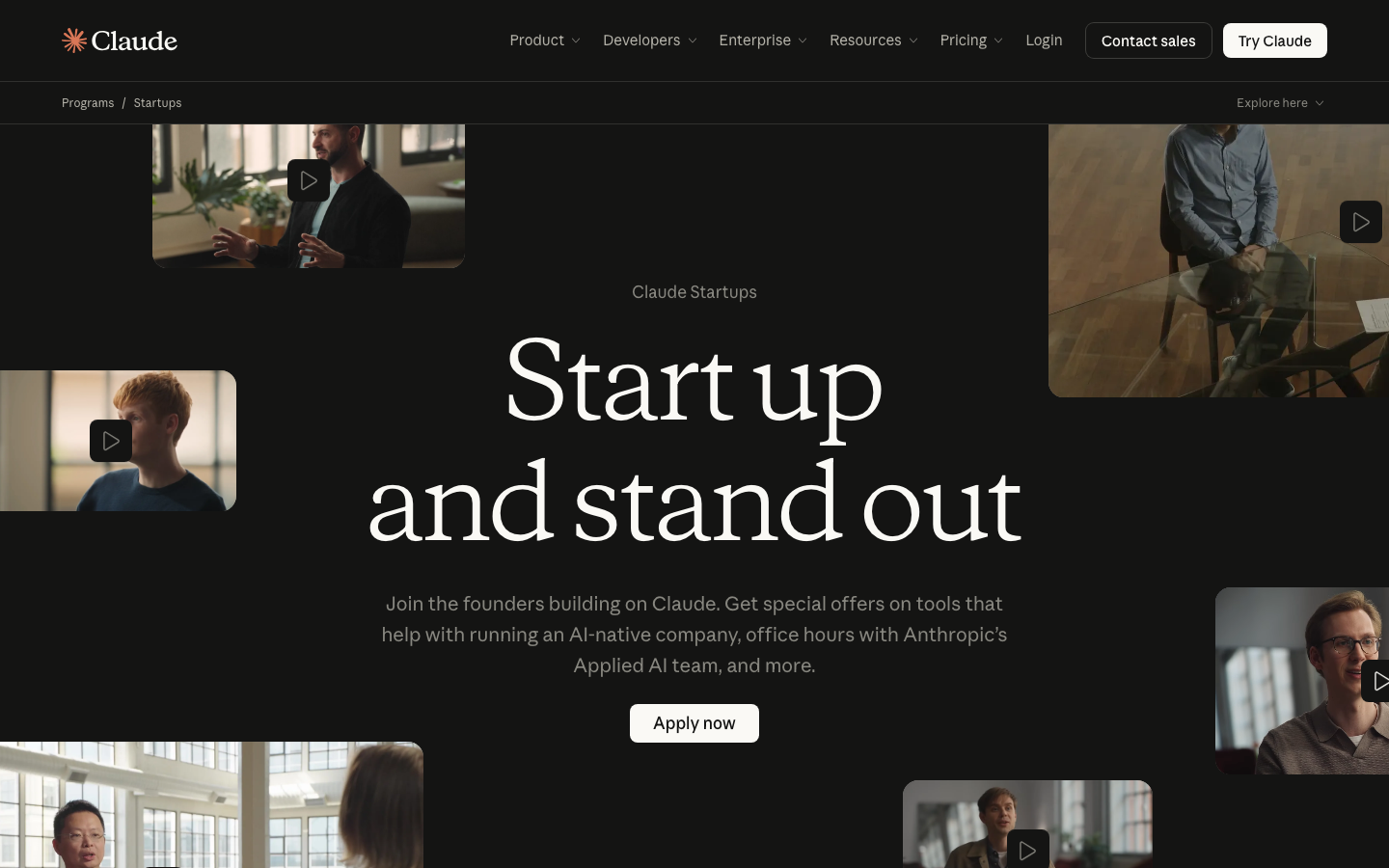
The Claude Startups program is Anthropic’s package of support for young companies building on Claude. Guides written before October describe it as limited to companies with institutional investors. The October 6 expansion opened it to founders who apply directly, and launch coverage described three benefits: a year of Claude Team, $1,000 in API credits, and a set of partner discounts.
The response was larger than Anthropic planned for. The FAQ on the program page now says, in its own words, that the company “didn’t anticipate the demand,” received “hundreds of thousands of applications over the past few days,” and is “currently over capacity on the Claude Team and $1,000 API credit offers.”
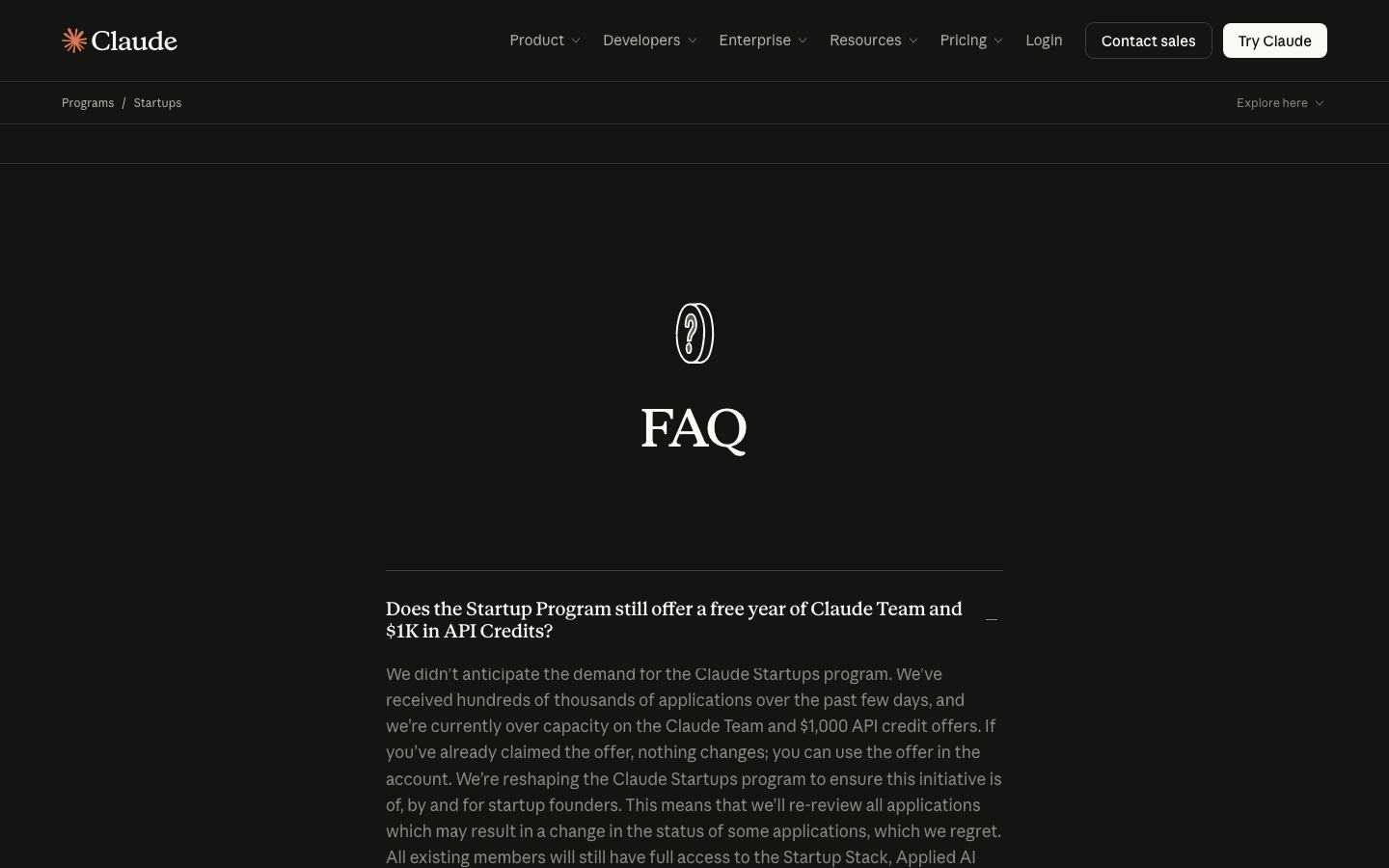
Three consequences follow from that notice, and each one affects whether and how you apply:
- If you already claimed the Team year or the credits, you keep them. Nothing changes for offers already in an account.
- New applicants should not expect them. The page’s main description no longer mentions either one. It now leads with partner offers and office hours.
- Every application is being reviewed again. Anthropic says it is reshaping the program to be “of, by and for startup founders” and that the re-review “may result in a change in the status of some applications.”
That last point matters if you were approved in the first days. An early acceptance may not be final.
Because the offer moved within a week, it helps to see the current state in one place. This table separates what a new member can count on today from what is paused.
| Benefit | Status on October 11, 2026 | Who provides it |
|---|---|---|
| Startup Stack partner offers | Open to members | Third-party companies |
| Applied AI office hours | Open to members | Anthropic |
| Events, hackathons, meetups | Open to members | Anthropic and community |
| Free year of Claude Team | Over capacity for new applicants | Anthropic |
| $1,000 in API credits | Over capacity for new applicants | Anthropic |
| Up to $100,000 extra API credits | Only through a partner-network investor | Anthropic, via your VC |
The program may change again, in either direction. Before you apply, read the first question in the FAQ on the program page. If the wording there differs from the quotes above, trust the page.
2.What You Get Today
With the two headline offers paused, the value of membership sits in three things: the Startup Stack, office hours with Anthropic’s engineers, and events. Each is worth a clear look, because none of them is cash.
The Startup Stack. This is a list of discounts and credits from companies that build their own products on Claude. Anthropic describes it as worth “up to $45,000.” Two details in the small print shape how to read that number. The offers come from independent third-party companies, not from Anthropic. And “up to” is the total if you used every offer at its maximum, which no single company will.
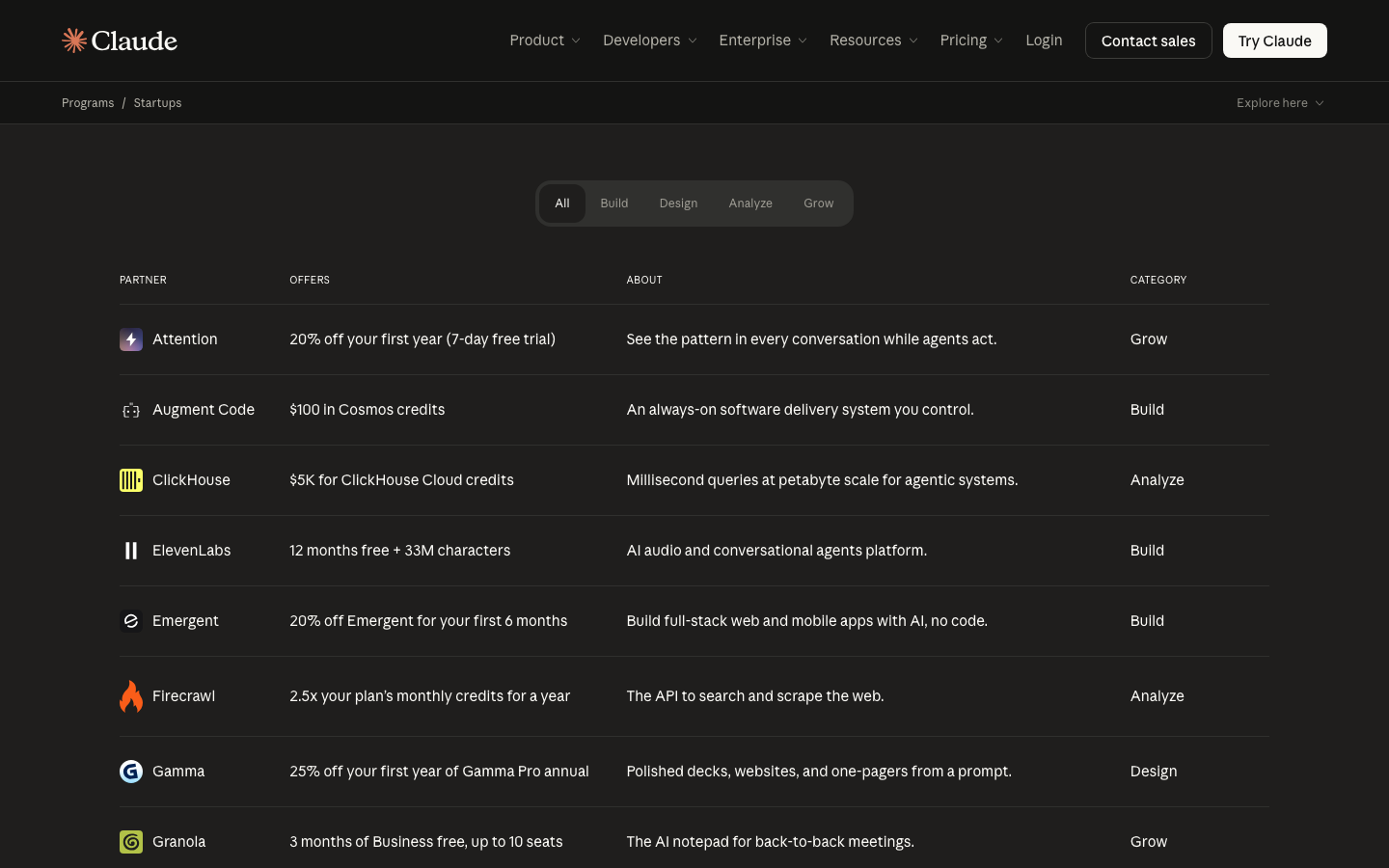
On October 11 the page listed 16 partners. The table below groups them by what kind of value they are, which is more useful than the alphabetical order on the page. A free period or a credit is worth something even if you were not already a customer. A percentage discount only helps if you were going to buy that product anyway.
| Kind of offer | Partner and offer |
|---|---|
| Free period on a paid plan | ElevenLabs: 12 months free plus 33 million characters. Linear: 6 months of Business. Hex: 6 months of Enterprise. Granola: 3 months of Business, up to 10 seats. Moda: 3 months of Pro, up to $3,000 in AI credits |
| Credits to spend | ClickHouse: $5,000 in cloud credits. Viktor: up to $1,500 over 3 months. Runable: $300 in credits plus 50% off the Max plan. Augment Code: $100 in credits |
| More usage on a plan you pay for | Firecrawl: 2.5 times your plan’s monthly credits for a year |
| Percentage discount | Gamma: 25% off the first year of Pro annual. Retool: 20% off the first year. Attention: 20% off the first year. Emergent: 20% off the first 6 months. Retell AI: 20% off the first 6 months. Lovable: 4 months off an annual Business plan |
For a solo founder, the first two rows are where the real value is. A year of ElevenLabs matters if you produce audio or video. ClickHouse credits matter if you run analytics at scale, and are worth nothing if you do not. Go through the list and mark only the tools you would use in the next three months.
Office hours. Members can join 45-minute live sessions with Anthropic’s Applied AI team, held every other week. This is the one benefit that comes directly from Anthropic’s engineers. It is most useful when you bring a concrete problem, such as a prompt that fails on certain inputs or an agent that costs too much to run.
Events. Members get access to Anthropic-hosted events such as Founder Days and hackathons, plus community meetups and online sessions.
Two conditions apply to credits, for anyone who does receive them. They work only on Anthropic’s own API through the Claude Console, not through AWS Bedrock or Google Cloud Vertex AI. And higher API rate limits come automatically with credits, so members without credits should not assume a rate-limit increase.
You have read this section correctly if you finish it with a short list of offers you would actually use, and you understand that each one is a deal with another company.
3.Who Qualifies
Eligibility is the part of this program with the most confident misinformation around it, so this section separates what Anthropic states publicly from what is only repeated elsewhere.
What Anthropic states on the program page today. You do not need venture funding. The FAQ says the program is “open to bootstrapped, pre-seed, and venture-backed startups.” Companies backed by an investor in Anthropic’s partner network may be eligible for up to $100,000 in additional API credits, claimed through that investor and not through the public form.
What the application form asks. The form gives strong hints about what reviewers look at. It asks for the month and year your company was incorporated, your latest funding round, and whether you raised outside funding in the last two years. It asks for a company website and your job title. It also requires you to accept two documents: the Startup Program Terms and an Additional Benefits Addendum.
What is widely repeated but not on the page today. Launch-week articles state that a company must have been founded within the last five years or funded within the last two, and that your email address must match your company’s website domain. The form’s questions fit those rules. But the current program page does not list them, and the terms that would settle the question sit behind the Console sign-in. We did not read those terms for this article, so we will not state thresholds, country restrictions or exclusions as fact.
The practical advice follows from that gap. The terms linked from the form are the authority. Read them before you submit, and check three things in particular: whether your company’s age and legal status fit, whether your country is included, and what the addendum says about benefits being changed or withdrawn.
Given the re-review, one more inference is reasonable, and it is only an inference. A program being reshaped “for startup founders” after a flood of applications is likely to look harder at whether an applicant is a real company building a product on Claude. An individual with a personal project and no website should expect a weaker case than an incorporated business with a live product. You are ready for the next step if you can describe your company in those terms honestly.
4.Prepare Before You Apply
Four things are easier to fix before you open the form than after. Two of them cannot be changed inside the form at all. Allow about half an hour.
1. An email address on your company’s domain. If you signed up for the Claude Console with a Gmail address, it does not match your website. We could not confirm from Anthropic’s page that a matching address is required, but it is widely reported, it is what a reviewer would expect from a real company, and it is cheap to fix. Most web hosts include free mailboxes. On ours, creating one took about five minutes: open the email section of the hosting panel, create an address such as hello@yourcompany.com, and the host adds the mail records for the domain automatically. Send yourself a test message before relying on it.
2. A Console organization named after your company. The form’s first field is your organization, and it is locked: it shows whatever your Claude Console organization is called and cannot be edited there. Ours had defaulted to an individual’s name. Rename it in the Console’s organization settings first, so the application carries your company name.
3. A website that shows what you are building. The form asks for a company website, and a reviewer may open it. It does not need to be elaborate. It should make clear what the product is and that it exists. If your product uses Claude, say so on the page.
4. Your incorporation date and funding facts. The “founded” field asks specifically for the month and year you incorporated, not when you started working on the idea. Have that date ready, along with your latest funding round if any. If you are bootstrapped, that is a valid answer and the program says so.
One optional step helps with the open questions on the form: check your current spending. The form asks what percentage of your monthly AI spend goes to Anthropic. Look at your last month’s bills so the number you give is real.
You are prepared when you can receive mail at your domain address, the Console shows your company name at the top of the organization settings, and you have the incorporation month and year written down.
5.Fill In the Application, Field by Field
To start, go to the Claude Startups program page and choose “Apply now.” It opens the application inside the Claude Console, where you sign in or create an account. The form is one page.
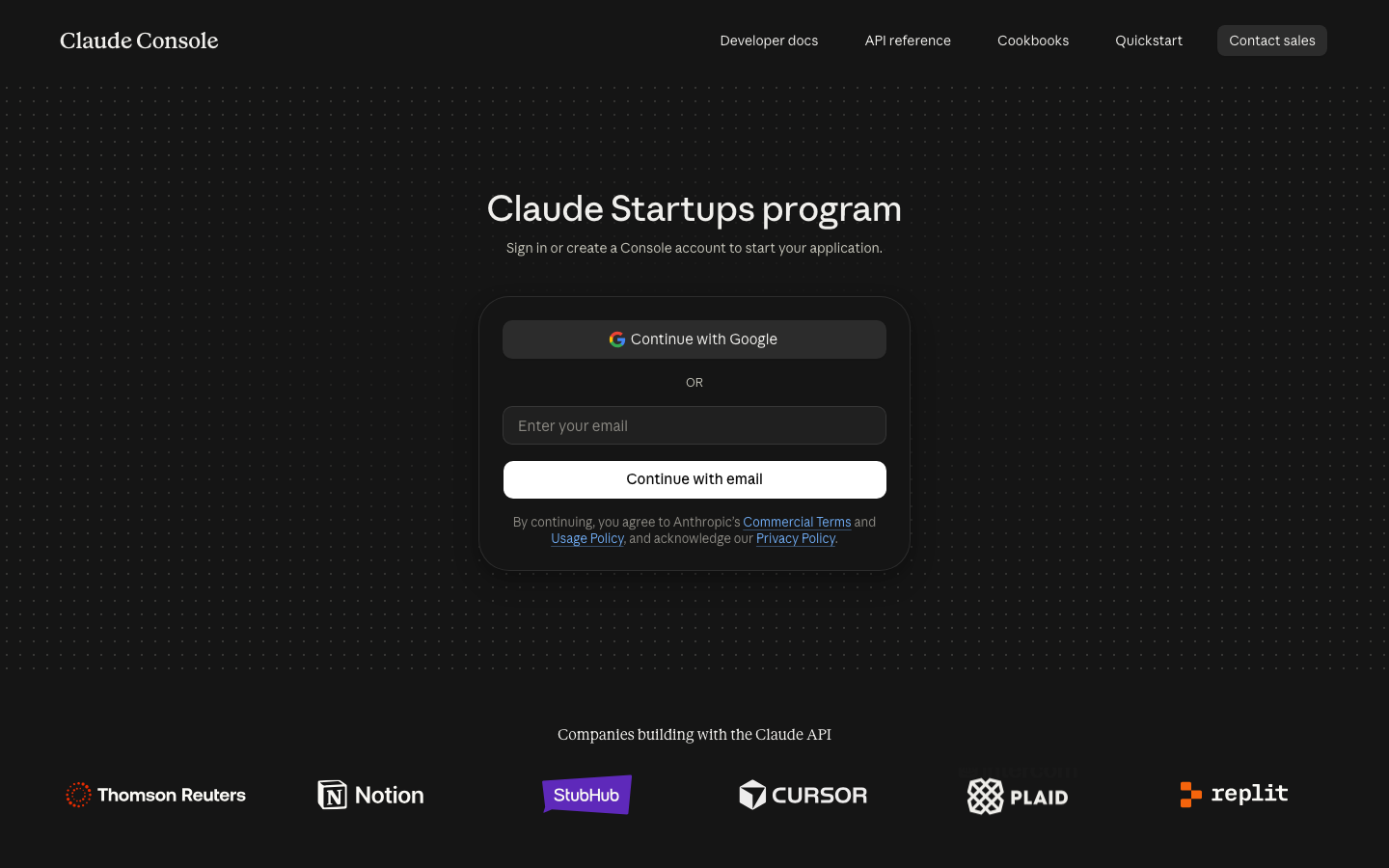
Most fields are factual. This table lists every field we saw on October 11, 2026, with a note where the answer is not obvious. Fields marked optional can be left blank.
| Field | What to enter |
|---|---|
| Organization | Filled in from your Console organization and locked. Rename it beforehand |
| First name, last name, job title | Yours. Use your real title; “Founder” is fine |
| Company name and website | The legal or trading name, and the site prepared earlier |
| Country; city (optional) | Where the company is based |
| Industry (optional) | The closest match |
| Founded | Month and year of incorporation |
| Latest funding round | Your actual stage, including bootstrapped |
| Raised outside funding in the last two years (optional checkbox) | Tick only if true |
| Investors (optional) | Name them if you have any; a partner-network investor is a separate route to credits |
| Where do you want support from Anthropic? | Open answer; see below |
| What % of your monthly AI spend is currently on Anthropic? | A real number from your bills |
| What are you building on Claude? | Open answer; see below |
| LinkedIn (optional) | Your profile, if it supports your case |
| Email updates (optional checkbox) | Your choice |
| Agreement to the Startup Program Terms and Additional Benefits Addendum | Read both first |
Two open questions carry most of the weight, because they are the only place a reviewer learns what you do. The same principles apply to both: be specific, be brief, and say only what is true and visible on your website.
“What are you building on Claude?” Answer in three parts: who the product is for, what it does, and exactly where Claude is used. Here is a generic example of the shape, not our own answer:
We build a scheduling assistant for independent dental practices. It reads
appointment requests from email and SMS and books them into the practice's
calendar. Claude classifies each incoming message, extracts the date and
treatment type, and drafts the confirmation. About 40 practices use it today.
“Where do you want support from Anthropic?” Name the real constraint. Reviewers can do something with “our extraction step fails on handwritten forms and we want guidance on evaluation,” and nothing with “any help would be great.” An example of the shape:
Two areas. First, cost: our classification step runs on every message and we
want advice on model choice and prompt caching. Second, reliability: we need a
sound way to evaluate extraction accuracy before we expand to a new country.
If you want help tightening your drafts, Claude can do it, as long as the facts stay yours. A prompt like this keeps it honest:
Before you submit, read the two linked legal documents. Then check your answers against your website. A reviewer who sees one product described on the form and another on the site has a reason to say no. The form is ready when a stranger could read your two open answers and explain your company to someone else.
6.After You Submit
Submitting the form starts a review, and acceptance is where the work of getting value begins. Each benefit needs a separate action.
The review. Anthropic says it aims to review every application within one week and to send the decision by email. Given the volume it has described, treat a week as a target and not a guarantee. Watch the inbox of the address on your Console account, including the spam folder.
The re-review. Because all applications are being looked at again, a status can change after you first hear back. Do not build plans on benefits until they are visible in your account.
Redeeming Startup Stack offers. Accepted members redeem each offer with a code found in the Claude Console. The codes are then used on the partner’s own site, under the partner’s own terms. Before redeeming, check three things on the partner’s page: whether the offer is for new customers only, whether it requires an annual commitment, and what the plan costs when the free or discounted period ends. A free six months on an enterprise plan can become an expensive renewal.
Booking office hours. Members receive a registration link by email and in the Claude Startups portal. Sessions run every other week. Prepare one concrete problem and the material needed to show it, such as the prompt, a failing input and the output you expected.
If you receive credits. They apply only to Anthropic’s own API through the Console. If your product calls Claude through AWS Bedrock or Google Cloud Vertex AI, the credits will not cover that usage. Launch coverage reported that credits expire six months after they are granted. Confirm the expiry date in your account and plan your usage against it.
If you are not accepted. The program page does not describe an appeal process. Nothing prevents you from building on Claude on standard terms, and a company that incorporates, launches a product or raises funding later will have a stronger application.
A short checklist covers the first week as a member:
- Confirm in the Console which benefits your account actually shows.
- Redeem only the offers on your shortlist, after reading each partner’s terms.
- Put renewal dates for any free period in your calendar.
- Register for the next office hours with one prepared question.
You have finished this stage when the offers you wanted are redeemed, a session is booked, and every free period has a reminder before it converts to a paid plan.
7.Is It Worth Applying as a Bootstrapped or Solo Founder
The application is a single page once you are prepared, and membership costs nothing. So the question is less “should I apply” than “what should I expect.” Three questions decide it.
Would you use at least two of the free-period or credit offers in the next three months? If yes, the Startup Stack alone repays the effort. A solo creator producing audio would get real value from the ElevenLabs offer. A small product team would from Linear and Granola. If the only offers that fit you are the 20% discounts, the saving is modest.
Do you have a real technical question for Anthropic’s engineers? Office hours are the one benefit that puts you in a live session with Anthropic’s own engineers. If you are building something where model choice, cost or reliability is a live problem, this benefit may be worth more than the discounts.
Are you applying for the Team year or the $1,000? If that is your only reason, the honest answer today is that you should not expect either. Anthropic has said it is over capacity on both, and it has not said whether or when they will reopen for new applicants.
That gives a simple reading by situation:
- Incorporated company with a live product on Claude: apply. You fit the program’s stated purpose, and the Stack and office hours are useful now.
- Solo creator or consultant with a business entity and a website: apply if the Stack fits your tools. Be precise about what you build with Claude.
- Individual with a side project and no company: your case is weaker, especially during the re-review. Read the terms first; it may be better to apply once the project is a registered business.
- Company backed by an investor in Anthropic’s partner network: ask your investor about the separate credit route before using the public form.
Whatever you decide, check the first FAQ answer on the program page on the day you apply. This program changed its core offer within a week of launching, and it may change again. Apply for what is on the page that day, and treat anything more as a bonus if it arrives.