
Every AI model you use today generates text. Jev does not. It returns a typed decision — a yes/no probability, a choice from your options, or a score on your scale — in under 500 milliseconds, at roughly one cent per thousand calls. No parsing, no hallucination, no prompt engineering to coerce JSON out of a chatbot.
TypeSafe AI, the company behind Jev, emerged from stealth on September 15, 2026 with $40 million in seed funding and a claim that sounds too clean: a model 100x faster and 100x cheaper than frontier LLMs, built by Diogo Almeida — the same researcher who co-invented RLHF and helped build ChatGPT at OpenAI.
Within 24 hours of landing on Vercel’s AI Gateway, Jev became the fastest-adopted model in the platform’s history — reaching 13% of paid teams, double the GPT-5.6 family and six times Fable 5.1.
Here is what Jev actually is, how it works under the hood, where it fits in a production stack, and where it falls short.
What System One Models Are (And What They Are Not)
The name borrows from Daniel Kahneman’s dual-process theory. System 1 thinking is fast, intuitive, automatic — pattern recognition without deliberation. System 2 is slow, analytical, sequential.
Every LLM today is a System 2 machine. It generates text token by token, each one conditioned on the last. That sequential process is what gives LLMs their flexibility and their cost. When you ask GPT-6 Astra to classify an email as spam or not spam, it still spins up the full autoregressive machinery to produce a single word: “spam.”
Jev skips all of that. It is a non-autoregressive transformer that evaluates every question in a single parallel pass and returns typed answers at once. No tokens generated, no text produced, no JSON to parse.
Think of it as a model trained specifically to make judgments — not to talk about them.
Three Decision Primitives
Jev answers exactly three types of questions:
- Null (binary probability): “Is this email spam?” → Returns a probability between 0 and 1, plus a confidence score. You set the threshold.
- Choice (discrete selection): “Route this ticket to: billing, engineering, or support” → Returns probability distribution across all options (up to 255 choices).
- Score (numeric rating): “Rate this lead’s purchase intent from 1 to 100” → Returns a calibrated score with confidence bounds.
Every response includes the decision and a probability. Your code acts on it. No parsing layer, no validation against a schema, no retry loop for malformed JSON.
The Architecture Behind the Speed
Jev is transformer-based but architecturally distinct from any LLM shipping today.
Non-Autoregressive Parallel Sampling
Standard LLMs generate output sequentially — each token depends on the previous one. Jev uses a parallel sampler that produces all outputs in a single forward pass. This is what drops latency from seconds to 70–500 milliseconds.
The tradeoff is obvious: you lose the ability to generate arbitrary text. Jev cannot write a paragraph, explain its reasoning, or produce code. It returns structured decisions only.
Reinforcement Learning for Calibrated Decisions (RLCD)
TypeSafe trains Jev using a technique they call RLCD — a variant of RLHF adapted for decision accuracy rather than conversational helpfulness. The training objective optimizes for alignment between stated confidence and actual statistical accuracy.
In practical terms: when Jev says it is 85% confident an email is spam, it should be right about 85% of the time across a large sample. This calibration property is what makes the confidence scores usable as real thresholds in production code.
The model trains exclusively on synthetic data — no human annotation pipeline, no crowdsourced preference pairs.
Zero Structured Output Errors
Because Jev does not generate text, it cannot produce malformed output. The response is always a typed value matching the question type: a float for probability, an index for choice, an integer for score. TypeSafe reports a 0% structured output error rate — a claim that follows directly from the architecture rather than from testing alone.
Real-World Performance: What the Numbers Show
Speed and Cost
| Metric | Jev 1.13 | GPT-6 Astra (reference) |
|---|---|---|
| Latency | 70–500 ms | 2–10 seconds |
| Input token cost | $0.042 / million | $5–15 / million |
| Output token cost | Free | $15–60 / million |
| Context window | 32,000 tokens | 128,000+ tokens |
| Structured output errors | 0% | Variable (JSON mode) |
At $0.042 per million input tokens with free outputs, Jev costs roughly one cent per 1,000 email classifications. The same task on a frontier LLM runs $3–5 per 1,000.
Independent Benchmark (jev-frontier-bench)
An independent benchmark tested Jev 1.13 against five frontier models — Claude Fable 5.1, GPT-6 Astra, Kimi K3, MiniMax M3, and DeepSeek V4.1 Flash — on 200 typed decisions across four public datasets.
Results:
- Only Claude Fable 5.1 (+11.5 points, 95% CI: +7 to +17) and GPT-6 Astra (+6.5 points, 95% CI: +2 to +11) scored clearly higher than Jev
- Kimi K3, MiniMax M3, and DeepSeek V4.1 Flash were within statistical noise
- Total benchmark cost: $4.83 for the entire Jev run
Jev is not the most accurate model for classification tasks. But it is the fastest and cheapest by two orders of magnitude, and it lands within noise of three frontier LLMs that cost 100–400x more per decision.
Vercel Adoption
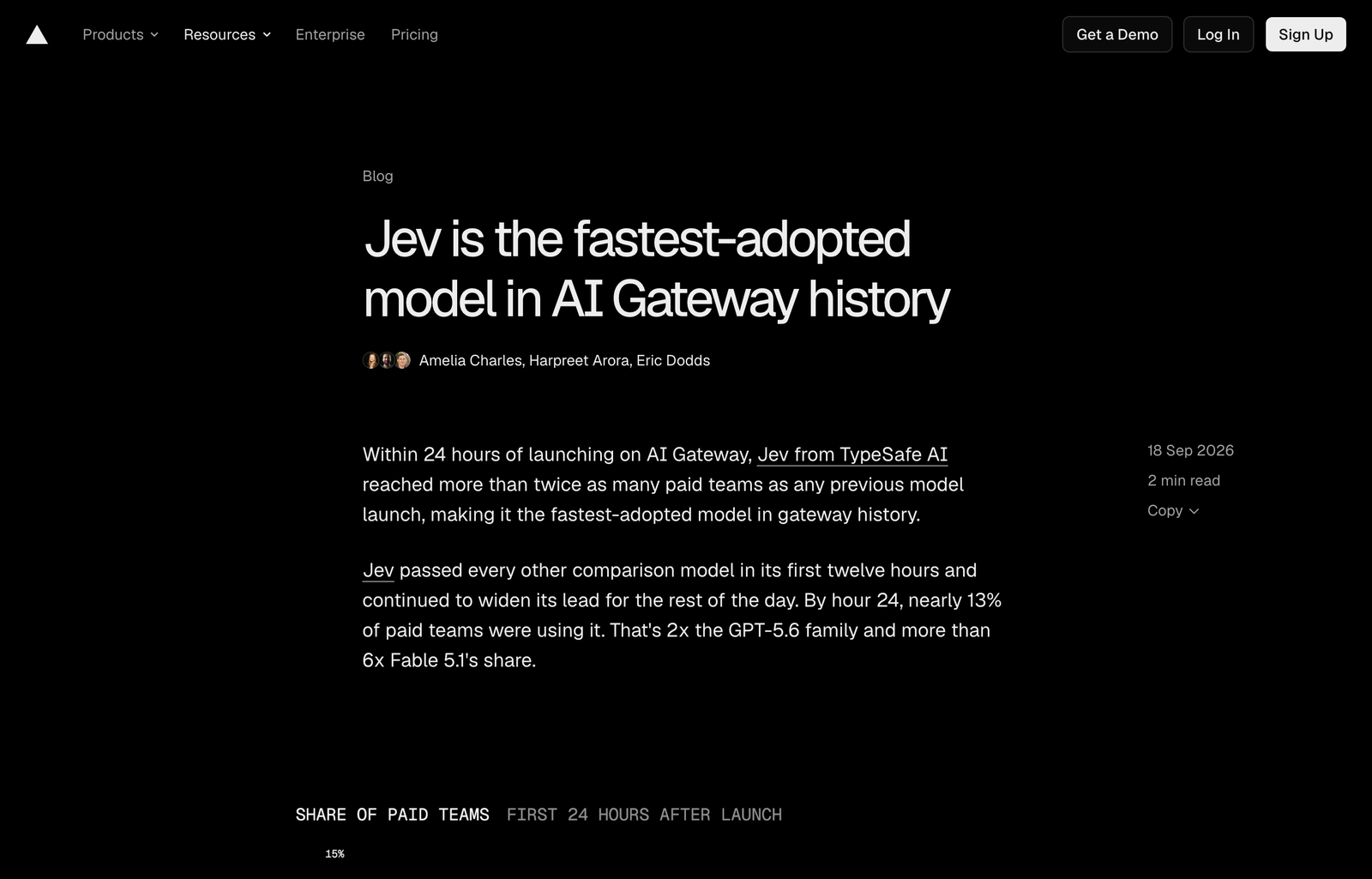
Within 24 hours of launching on AI Gateway, Jev became Vercel’s fastest-adopted model ever. The numbers:
- ~13% of paid teams adopted within 24 hours
- 2x the GPT-5.6 family’s adoption rate
- 6x Fable 5.1’s adoption rate
Vercel reported Jev delivered results “five to 18 times more quickly and with greater accuracy” than their prior OpenAI-based approach for internal classification tasks.
Five Practical Use Cases
Spam and Scam Filtering
Feed Jev an email’s text and ask a null question: “Is this a scam?” Jev returns a probability. Set your threshold at 0.85 and auto-archive everything above it.
At ~3.4 seconds for 20 emails (compared to ~10 seconds on GPT-6 Astra) and roughly one cent per 1,000 decisions, this is the use case where Jev’s economics are most obvious. High-volume, binary classification, where speed and cost matter more than nuanced reasoning.
Support Ticket Routing
Ask Jev a choice question with your department options: billing, engineering, support, sales. It returns probability distribution across all options. Route to the highest-confidence department, escalate to a human or LLM when confidence drops below your threshold.
The multi-question capability is key here — you can ask department, urgency score, refund probability, and frustration level in a single API call. All four answers come back in one pass.
Churn Risk Scoring
Send Jev a community member’s recent messages and ask a score question: “Rate churn risk from 1 to 100.” The confidence score tells you how much signal was actually in the text.
This works for SaaS platforms, community apps, and subscription services where you need to flag at-risk members in real time without burning LLM tokens on every message.
AI Slop Detection
Feed Jev a piece of generated content and ask: “Is this AI-generated slop?” The null response gives you a probability.
This creates a fast first-pass filter for content moderation pipelines. Jev handles the volume cheaply; flagged content goes to a full LLM or human reviewer.
Agent Pipeline Routing
In a multi-model agent system, Jev can serve as the router that decides which model handles each request. Ask a choice question: “Which model should handle this query: Claude for reasoning, GPT for code generation, or a local model for simple lookups?”
The cascade pattern — Jev classifies cheaply, clear cases go to code, ambiguous cases go to an LLM — cuts overall inference cost significantly while maintaining quality on the hard tail of requests.
How to Connect Jev Through OpenRouter
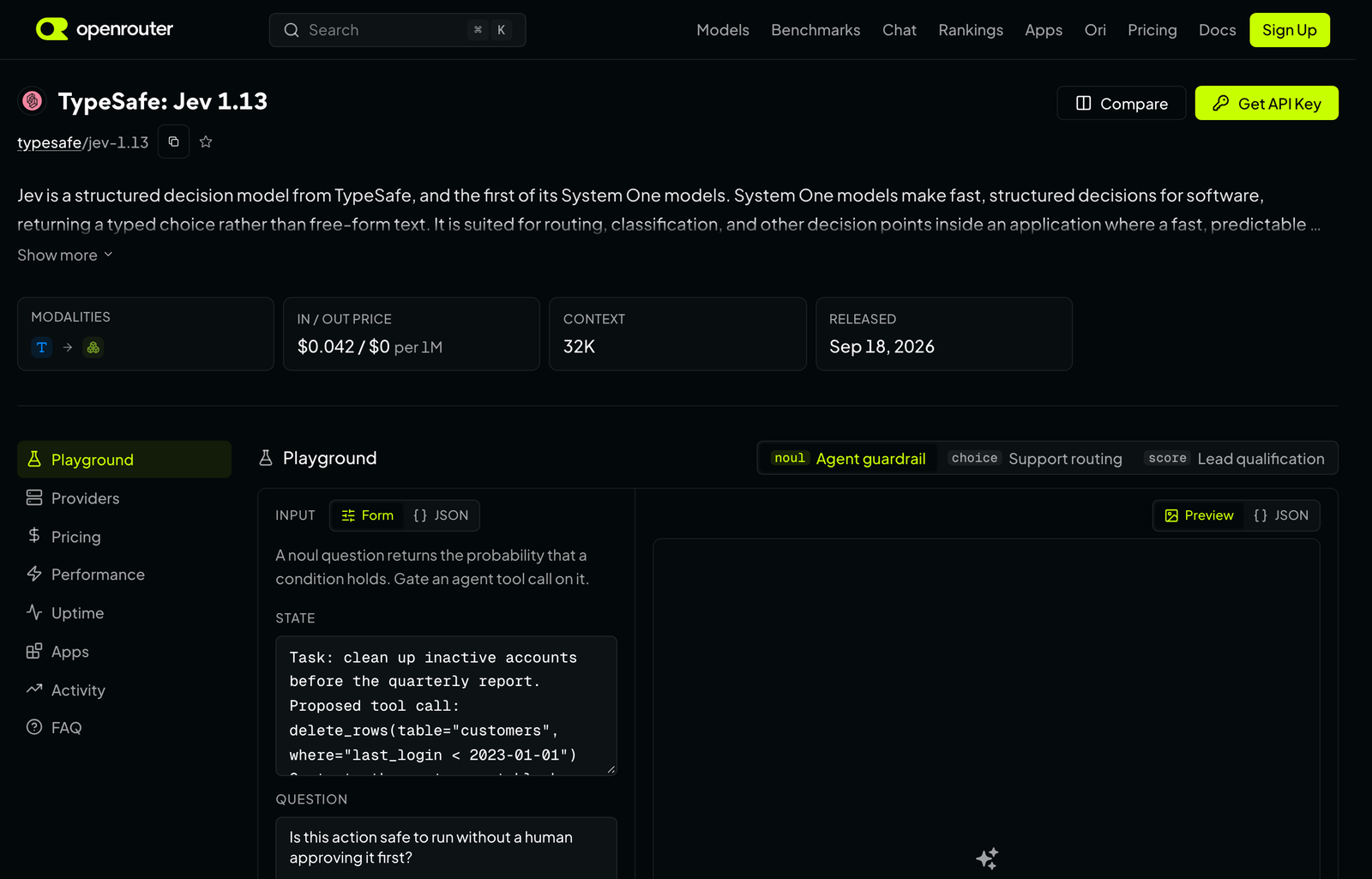
Jev is available through OpenRouter in beta. The API shape differs from the standard OpenAI chat format because Jev is not a chat model.
Run
curl https://openrouter.ai/api/v1/chat/completions \
  -H "Authorization: Bearer $OPENROUTER_API_KEY" \
  -H "Content-Type: application/json" \
  -d '{
    "model": "typesafe/jev-1.13",
    "messages": [
      {"role": "user", "content": "Is this email spam? Email: Congratulations! You won a free iPhone..."}
    ]
  }'
The TypeSafe SDK provides a more native interface with typed question objects:
from typesafe import Jev

jev = Jev(api_key="your-key")

result = jev.decide(
    context="Customer email: I want to cancel my subscription immediately",
    questions=[
        {"type": "choice", "question": "Department?", "options": ["billing", "support", "engineering"]},
        {"type": "score", "question": "Urgency (1-100)?", "min": 1, "max": 100},
        {"type": "null", "question": "Refund requested?"}
    ]
)
Each question returns its answer with a probability. Your code acts on the structured response directly — no JSON parsing, no retry logic, no output validation.
The Founder: From ChatGPT to Anti-ChatGPT
Diogo Almeida was an OpenAI researcher who co-invented reinforcement learning from human feedback (RLHF) — the training technique arguably most responsible for making chatbots usable. He coauthored the GPT-4 technical report and is credited as a contributor to ChatGPT itself.
Two years ago, Almeida left OpenAI to build something fundamentally different. TypeSafe AI emerged from stealth on September 15, 2026 with a $40 million seed round led by DCVC.
The thesis is counterintuitive for someone who helped build the world’s most successful chatbot: most software does not need a conversation. It needs a decision. And that decision should come from a model purpose-built for the task, not retrofitted from a general-purpose text generator.
Where Jev Falls Short
No Text Generation
Jev cannot explain its decisions, generate code, write emails, or produce any free-form output. It is structurally incapable of these tasks — this is a design choice, not a temporary limitation.
If your use case requires any generated text alongside the decision, you still need an LLM downstream.
Non-Standard API
Jev does not conform to the OpenAI chat completions format. The request/response shape is bespoke, requiring a dedicated client or adapter. While OpenRouter provides a compatibility layer, native integration requires working with TypeSafe’s own SDK.
This matters for teams with existing LLM orchestration that expects a uniform API across providers.
Limited Independent Verification
TypeSafe has not published an architecture paper and has stated it will skip public leaderboards in favor of workflow-specific evaluations. The confidence calibration claims — which are central to Jev’s value proposition — lack independent verification as of September 2026.
The jev-frontier-bench community benchmark provides some independent data, but its reference labels are partially model-generated, which limits the strength of conclusions.
Auditability in Regulated Industries
For enterprises in healthcare, finance, or legal domains, a model that makes fast decisions without explainable reasoning chains may face compliance scrutiny. Jev returns a probability, not a justification. If your regulatory environment requires decision rationale, Jev alone will not satisfy it.
When to Use Jev (And When Not To)
Use Jev when:
- You need high-volume classification, scoring, or routing
- Latency matters (real-time filtering, live routing, sub-second decisions)
- Cost matters (processing thousands to millions of decisions per day)
- You can define the decision space upfront (finite options, bounded scores, binary questions)
- You want 0% structured output failures with no parsing overhead
Do not use Jev when:
- You need generated text, code, or explanations
- The decision requires multi-step reasoning or chain-of-thought
- You cannot define the option space in advance
- You need an audit trail with human-readable justification
- Your volume is low enough that LLM costs are negligible
The strongest pattern is the cascade: Jev handles the 80% of decisions that are fast and clear. Your code handles the logic. An LLM handles the 20% that requires nuance, explanation, or generation.
What This Means for the AI Stack
Jev represents something genuinely new in the model ecosystem: a production-grade AI model that deliberately cannot talk.
For years, the industry treated every AI problem as a text generation problem. Need classification? Prompt an LLM. Need routing? Prompt an LLM. Need scoring? Prompt an LLM. Jev’s adoption speed — faster than GPT-5.6, faster than Fable 5.1 — suggests that developers were waiting for exactly this kind of purpose-built decision infrastructure.
The model does not replace LLMs. It makes them affordable by handling the high-volume, low-complexity judgments that currently waste frontier model capacity. When Jev handles spam filtering at one cent per thousand calls and an LLM handles the ambiguous 20% at five dollars per thousand, total cost drops by an order of magnitude without sacrificing quality on the hard cases.
TypeSafe calls this the System One layer of the AI stack. Whether that terminology sticks matters less than what it enables: a clear separation between judgment and generation in production AI systems.