At Anthropic’s Code with Claude conference, CEO Dario Amodei made a specific prediction: the first billion-dollar company run by a single person will emerge in 2026. When pressed, he put the probability at 70 to 80 percent.
That prediction was not about AI replacing workers. It was about what happens when one person can deploy capabilities that previously required departments. Amodei pointed to sectors where “you don’t need a lot of human-institution-centric stuff to make money” — proprietary trading, developer tools, automated customer-facing products.
Nine months later, Anthropic backed the idea with infrastructure. Claude for Small Business launched in May 2026 with 15 agentic workflows, connectors to QuickBooks, HubSpot, PayPal, and seven other platforms, and a Solopreneurship Accelerator program with seed funding and Claude credits for its first cohort.
Here is what that infrastructure actually enables, which business models work best with it, and where the limits are.
| Strategy | What Claude Handles | Revenue Model | Time to First Revenue | Capital Required |
|---|---|---|---|---|
| Vertical SaaS | Product development, customer support, iteration | Subscriptions ($29–$299/month) | 4–8 weeks | $20–$200/month (Claude plan) |
| Done-for-You AI Services | Client deliverables, automation setup, reporting | Project fees ($1,500–$5,000) + retainers ($200–$500/month) | 1–2 weeks | $20/month |
| Content Operations | Writing, SEO, email sequences, social assets | Retainers ($2,000–$8,000/month) | 1 week | $20/month |
| Internal Tool Builder | Code generation, API integration, deployment | Per-tool pricing ($3,000–$15,000) | 2–4 weeks | $100–$200/month |
| Automated Lead Pipeline | Lead gen, proposal drafting, onboarding flows | Performance fees or retainers | 2–3 weeks | $100/month |
1. What Amodei Actually Said — And What He Didn’t
The billion-dollar solopreneur prediction came during a Q&A with Anthropic CPO Mike Krieger (co-founder of Instagram). Amodei’s first guess for the sector was proprietary trading — a field where one person with the right algorithms can manage billions without needing a sales team, customer support, or physical infrastructure.
His second example was developer tools. A single founder building software for other developers can grow fast because the customers are technical, the sales cycle is short, and the product can be distributed digitally with near-zero marginal cost.
What Amodei explicitly did not say: that any solo founder with Claude can build a billion-dollar company. The prediction was about a specific intersection of AI capability and capital-light business structures. The sectors he identified share three properties:
- Low human-institution overhead: No sales teams, minimal regulatory compliance, no physical inventory
- Digital distribution: The product reaches customers through software, not through people
- Compounding returns: Each improvement to the product benefits every customer simultaneously
Most solo AI businesses will not reach a billion dollars. But the structural advantage Amodei described — one person operating with the output capacity of a team — applies at every revenue scale.
2. The Claude Infrastructure That Makes It Work
Anthropic has built Claude into a full operating environment, not just a chat interface. Understanding the specific tools matters because each one replaces a different operational role.
2.1 Claude Code: Your Development Team
Claude Code is a terminal-based coding agent that reads your codebase, writes and edits files, runs tests, and deploys changes. For a solo operator, this replaces the need to hire developers for:
- Building web applications and internal tools from scratch
- Debugging and maintaining production code
- Writing database queries, API integrations, and deployment scripts
- Generating documentation and test suites
Connor, a 23-year-old with no programming background, used Claude Code to turn competitor screenshots into a live application. The result was not a prototype — it was a functional product.
2.2 MCP Connectors: Your Operations Staff
Model Context Protocol connects Claude to over 6,000 applications. Instead of manually transferring data between tools or hiring an operations person to manage workflows, Claude reads from and writes to your business systems directly.
For a solo business, the high-value MCP connections include:
- Financial: QuickBooks for bookkeeping, PayPal for payment tracking, Stripe for subscription management
- Sales and CRM: HubSpot for pipeline management, lead scoring, and follow-up sequences
- Communication: Slack for team-of-one status updates and client channels, Gmail for email triage
- Development: GitHub for code management, Jira or Linear for project tracking
- Design: Figma for design iteration, Canva for quick marketing assets
2.3 Claude for Small Business: Pre-Built Workflows
Launched in May 2026, this package provides 15 agentic workflows that run through Claude Cowork. The meaningful ones for solo operators:
- 30-day cash forecasting: Pulls QuickBooks data, projects cash flow, flags potential shortfalls
- Overdue invoice chasing: Identifies unpaid invoices, drafts follow-up emails, tracks responses
- Monday morning business pulse: Summarizes cash position, pipeline status, and upcoming commitments in one report
- Contract review: Analyzes agreements before you sign, flags unfavorable terms, suggests modifications
- Lead triage: Scores incoming leads based on your criteria, prioritizes follow-up
These workflows are not autonomous agents running your business. They are structured task runners that execute specific operations you would otherwise do manually — or hire someone to do.
2.4 Projects and Memory: Your Institutional Knowledge
Claude Projects lets you create persistent workspaces with knowledge base files, custom instructions, and conversation history. Memory retains information across sessions within each project scope.
For a solo business, this means Claude can maintain context about your specific clients, products, brand voice, pricing structure, and operational procedures without you re-explaining them every session. One project for client work, another for product development, another for marketing — each with its own accumulated context.
3. Five Business Models That Work for Solo AI Operators
3.1 Vertical SaaS: One Industry, One Workflow
The strongest signal from real solopreneur success stories is specificity. The most profitable approach is not building a general AI tool — it is building a Claude-powered solution for one specific workflow in one specific industry.
Marc Lou generated $1,032,000 in 2025 revenue across three developer tools (ShipFast, CodeFast, DataFast) with zero employees. Each tool solves one narrow problem for one audience. Pieter Levels built fly.pieter.com from idea to $1M ARR in 17 days.
The pattern: choose a workflow that professionals currently do manually, that involves text/data processing (where Claude excels), and that recurs frequently enough to justify a subscription.
Examples that fit: contract clause extraction for real estate agents, patient intake form processing for clinics, building permit document assembly for contractors, compliance report generation for financial advisors.
3.2 Done-for-You AI Services
The lowest barrier to revenue. You use Claude to deliver work that clients would otherwise hire a consultant or agency for, charging project fees of $1,500 to $5,000 plus monthly retainers.
Daojie, a marketer, built 70 Claude AI agents and drove $1.25 million in client revenue in two months. The key was not the technology — it was positioning as someone who delivers business outcomes using AI, not someone who sells AI itself.
Service categories with strong demand: custom automation setup for small businesses, AI-powered content systems, CRM optimization and lead scoring, operational workflow design and implementation.
3.3 Content Operations at Scale
A solo founder can use Claude to produce the content volume of a small agency. Blog posts, SEO landing pages, email nurture sequences, social media calendars — Claude handles the first draft, research synthesis, and formatting while you handle strategy, voice, and client relationships.
Revenue: monthly retainers of $2,000 to $8,000 per client, with 3 to 5 clients producing a healthy solo income. Claude Pro at $20/month is the only infrastructure cost beyond your time and expertise.
3.4 Internal Tool Building
Companies need custom internal tools but do not want to hire full development teams for them. A solo operator using Claude Code can build CRM dashboards, inventory management systems, reporting tools, and workflow automation at a fraction of agency pricing.
Pricing: $3,000 to $15,000 per tool, with optional maintenance retainers. Claude Max at $100 to $200/month provides the extended usage needed for sustained development work.
3.5 Automated Lead Pipeline
Using n8n or similar orchestration tools alongside Claude, you can build pipelines that handle lead generation, instant proposal drafting, content creation, and self-service client onboarding — all running without your direct involvement.
This model works best for digital services: web development, copywriting, design, consulting. The pipeline does not replace the service delivery, but it eliminates the time you would otherwise spend on business development.
4. The $20 to $200 Decision: Which Claude Plan for Business
Claude’s pricing scales with usage, not features. Every plan gets the same models and capabilities. The question is how much you need.
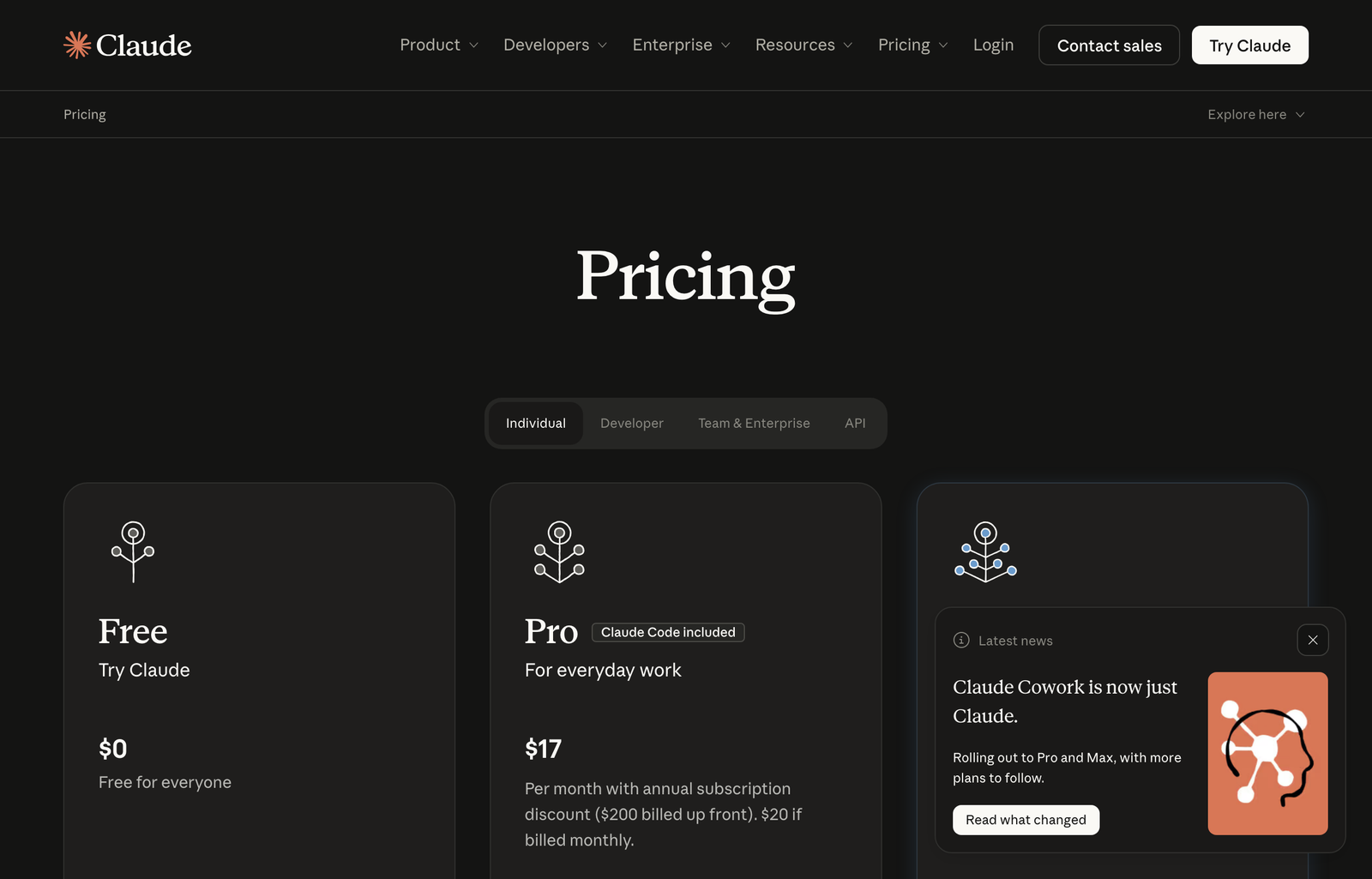
Claude Pro ($20/month): Sufficient for content operations, done-for-you services where you are the execution layer, and early-stage product development. You get extended thinking, Projects, and MCP access.
Claude Max 5x ($100/month): Right for active development work with Claude Code, building internal tools, or running a higher volume of client deliverables. Five times Pro’s usage capacity handles sustained coding sessions and complex multi-step workflows.
Claude Max 20x ($200/month): For serious product development — building and maintaining a SaaS product, running automated pipelines, or handling enterprise-level client work. The highest usage tier before Team or Enterprise plans.
For most solo operators starting out, Pro at $20/month provides enough capacity to validate a business model and land the first clients. Upgrade when you are consistently hitting usage limits, not before.
5. Where This Breaks Down
Amodei’s prediction has specific conditions. A solo AI business works well in some contexts and poorly in others.
What works: Digital products and services, technical audiences, text/data-heavy workflows, subscription or retainer revenue models, businesses where the product improves with iteration rather than human scaling.
What does not work: Businesses requiring regulatory licenses (law, medicine, finance advising), physical product manufacturing, industries requiring in-person relationships (enterprise sales, real estate brokerage), work requiring domain credentials the operator does not have.
Claude-specific limitations:
- Claude does not browse the web autonomously in most configurations. Real-time market research still requires human direction.
- Long-running autonomous tasks (multi-hour processes) need careful orchestration and error handling. Claude is not a set-and-forget worker.
- Output quality depends entirely on input quality. “Build me a SaaS” produces mediocre results. “Build a Next.js app with Stripe integration that tracks X metric for Y audience using Z data source” produces usable code.
- The 70 to 80 percent probability Amodei assigned to his prediction was for a specific class of business. Extrapolating it to every solo venture is a misread of the claim.
6. Getting Started: The First 30 Days
Week 1: Choose a business model from the five above. Pick the one closest to skills you already have — Claude amplifies existing expertise, it does not create it from nothing.
Week 2: Set up your Claude workspace. Create Projects for each business function (product, clients, marketing, operations). Connect MCP integrations to your financial and communication tools. If building software, install Claude Code and start with a small internal tool.
Week 3: Deliver your first paid work or launch your MVP. For services, land one client through your existing network. For products, ship a minimum viable version and get it in front of 10 potential users.
Week 4: Measure what worked. Which Claude workflows saved the most time? Where did you still need to do things manually? Double down on the Claude tasks that saved the most time and build systems around them.
The Solopreneurship Accelerator that Anthropic launched with the Workday Foundation and LISC provides seed funding and Claude credits for its first cohort of 15 founders. The free AI Fluency for Small Business course, built with PayPal, is available to everyone regardless of the accelerator program.
Whether or not the first billion-dollar solopreneur emerges in 2026, the infrastructure for one-person businesses operating at previously impossible scale is live and priced at $20 to $200 per month. The prediction matters less than the capability.