
OpenSEO and Claude SEO both put search work inside an AI coding agent, but they solve different bottlenecks. OpenSEO gives Claude access to live keyword, ranking, backlink, competitor, and Search Console data. Claude SEO gives Claude a structured audit system that delegates technical, content, schema, local, international, and AI-search checks across specialist workflows.
That distinction matters more than their similar GitHub descriptions. If your agent lacks current search data, another audit prompt will not fix it. If you already have Search Console and crawl data but no repeatable way to turn findings into a prioritized plan, another dashboard will not fix that either.
The practical choice is not “which tool does SEO for me?” It is “do I need a data layer, an analysis layer, or a controlled combination of both?”
| Workflow | Primary job | Data model | Cost shape | Best fit |
|---|---|---|---|---|
| OpenSEO: the data layer | Supply live search and competitor data to an agent | Hosted or self-hosted app plus MCP | $10 hosted base plan or self-hosted DataForSEO usage | Operators missing an agent-ready SEO dataset |
| Claude SEO: the analysis layer | Run repeatable audits and produce prioritized findings | Local plugin, skills, agents, and optional extensions | Free core; external APIs and services cost extra | Teams with site evidence that need consistent analysis |
| The operating loop: evidence before content | Turn measurements into small, testable changes | Search Console, analytics, site crawl, editorial review | Existing tools plus implementation time | Anyone using AI for content or technical SEO |
| Which setup should you choose? | Match the stack to the actual bottleneck | One tool or both run side by side | Depends on data depth and audit scope | Practitioners who want a defensible starting point |
OpenSEO: the data layer
OpenSEO is an SEO application before it is an agent skill. It stores projects, keywords, rankings, competitors, backlink summaries, site-audit results, AI visibility checks, and shared business context. Its MCP server exposes that information to Claude Code, Codex, Cursor, and other compatible clients. Separate `SKILL.md` workflows tell the agent how to use those tools for jobs such as keyword research, clustering, competitor analysis, local SEO, and link prospecting.
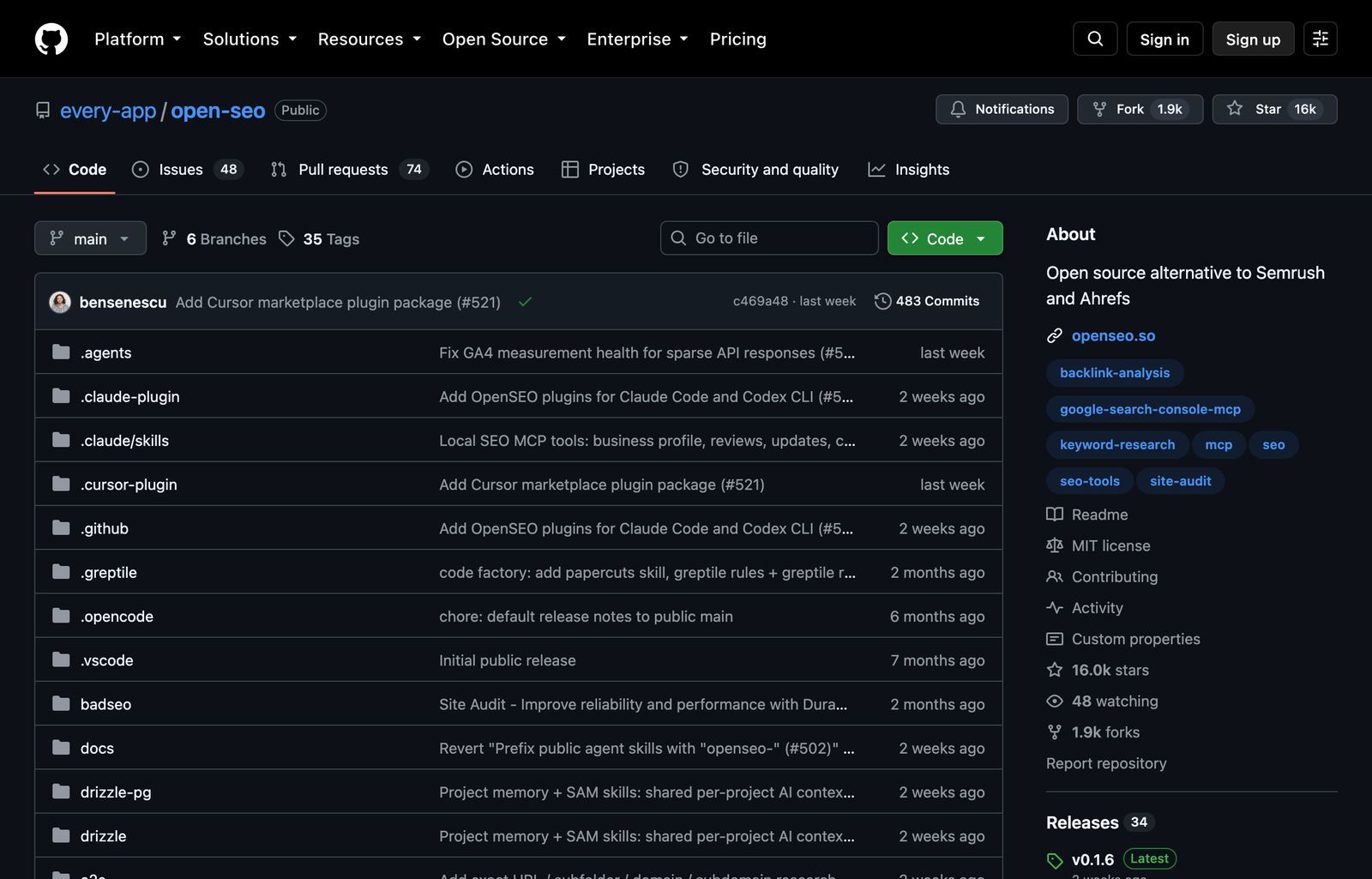
That split between MCP and skills is the key architectural decision. MCP supplies capabilities and current records; skills supply procedure. A plain prompt such as “find content opportunities” leaves the agent to invent both the analysis method and the output contract. An OpenSEO skill can instead retrieve a known project, hydrate keyword metrics, compare live SERPs, save selected terms, and write the result back to shared project context.
What you actually install
The smallest Claude Code setup is the official plugin, which installs the MCP connection and nine focused SEO skills together. The standalone skills installer is useful when you want the workflows without the complete plugin. If you have not worked with reusable skill packages before, this review of practical Claude Code skills explains what the instruction layer contributes beyond a prompt:
Install
npx skills add every-app/open-seo --skill '*' --agent claude-codeYou can also connect the hosted MCP endpoint directly, but then the skills remain a separate installation. This matters during troubleshooting: a working MCP connection does not guarantee that `/keyword-research` or `/seo-audit` exists, and an installed skill does not guarantee that the authenticated data tools are available.
Open source does not mean free search data
The repository is MIT licensed, but current SEO data still has a supplier. OpenSEO uses DataForSEO for keyword, SERP, backlink, competitor, and audit requests. The hosted plan was $10 per month when verified on September 1, 2026, including $10 of usage. Self-hosting removes the hosted markup and subscription interface, not the underlying API bill.
Docker self-hosting also ships with local authentication disabled. OpenSEO’s documentation tells operators to place it behind an authenticated reverse proxy, tunnel, or private network before exposing it. That is not a minor deployment footnote: projects can contain competitor lists, Search Console records, positioning notes, and keyword research that should not sit on a public unauthenticated endpoint.
When OpenSEO is the wrong first move
Do not start with OpenSEO when the site has no reliable analytics setup, no clear conversion pages, and no operator willing to act on the output. More keyword rows do not resolve an unclear business model. It is also unnecessary when your immediate job is a one-page technical review that public crawling and PageSpeed data can answer without a persistent keyword database.
OpenSEO earns its place when multiple workflows need the same current data. Rank tracking should reuse the selected keywords. A content brief should reuse positioning and competitors. A later audit should see the same project history instead of starting from an empty context window.
Claude SEO: the analysis layer
Claude SEO takes the opposite starting point. It is a Claude Code plugin built around 25 sub-skills and 18 specialist agents. The core orchestrator can delegate technical SEO, content quality, schema, images, sitemaps, local SEO, hreflang, programmatic SEO, e-commerce, search experience, and AI-search analysis, then reduce those findings into a prioritized action plan.
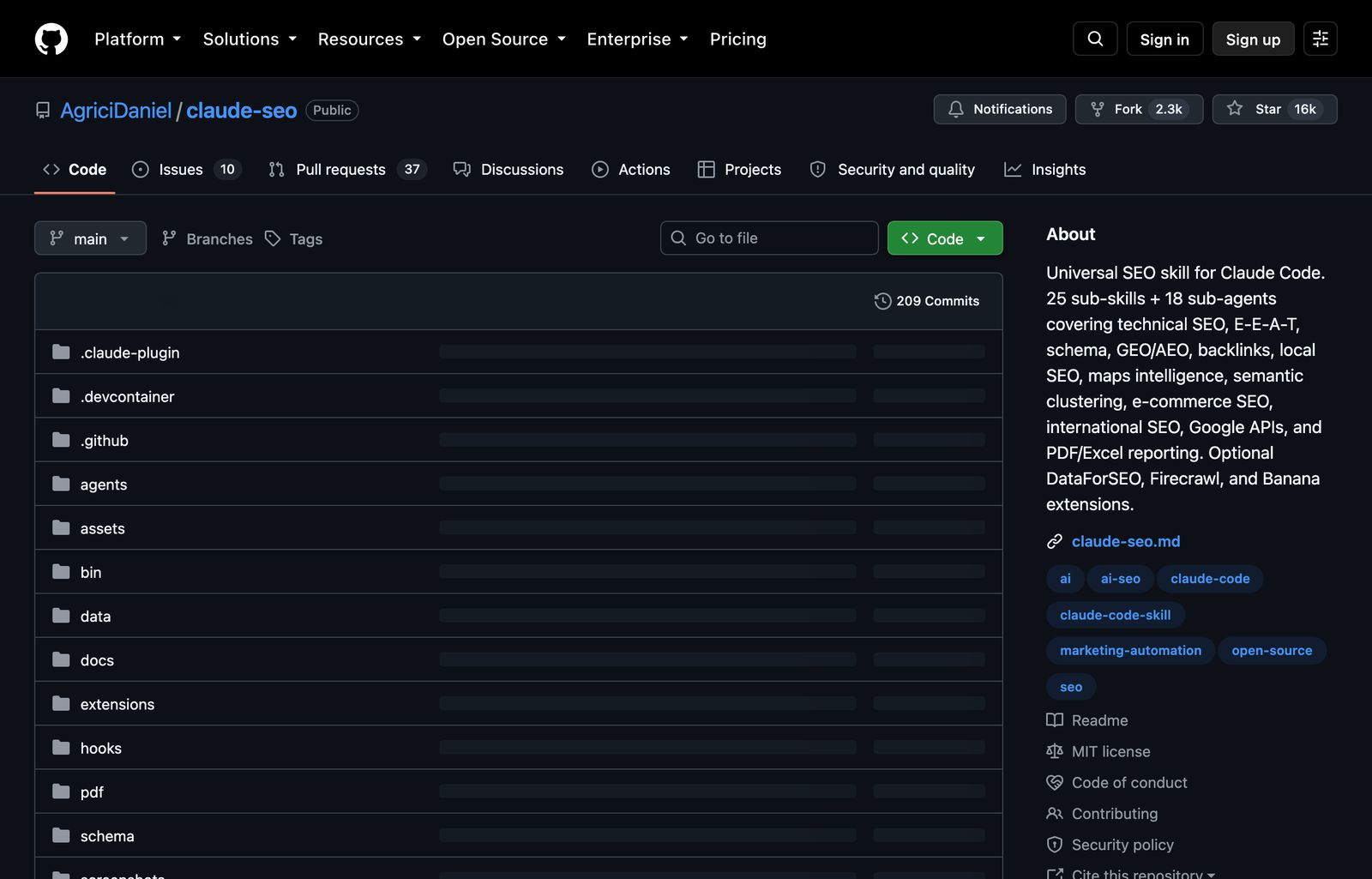
Its useful abstraction is the audit contract. Instead of asking one model to crawl a site, remember every rule, interpret conflicting signals, and rank fixes in a single pass, the plugin gives each domain a narrower procedure and reference set. A full audit can fan out to specialist agents; a page review can stay focused on one URL.
The commands map to decisions, not just reports
The core command surface includes focused entry points:
/seo audit https://example.com
/seo page https://example.com/about
/seo technical https://example.com
/seo content https://example.com
/seo schema https://example.com
/seo geo https://example.com
This is more useful than a single universal audit prompt because the operator chooses the scope before the agent starts. `/seo page` should not spend the run building an international strategy. `/seo schema` should not bury invalid JSON-LD below a hundred unrelated suggestions. Narrow commands make the result easier to validate and rerun after a fix.
The free core has a data ceiling
Claude SEO can fetch public URLs and run without paid enrichment. That is enough for HTML structure, metadata, schema, crawl signals, content review, and lab performance checks. It is not enough to know which queries produced impressions, whether a URL is indexed according to Search Console, how rankings changed, or which competitor keywords have material volume.
Google credentials add Search Console, GA4, CrUX, PageSpeed, and indexation evidence. Optional extensions add DataForSEO, Firecrawl, Ahrefs, SE Ranking, Profound, Bing Webmaster, and Unlighthouse. The plugin therefore becomes more capable as you connect evidence, but its “free” mode should be described accurately: the orchestration is free, while comprehensive market and first-party performance data requires accounts, credentials, or paid services.
Parallel audits still need an owner
Eighteen agents can find eighteen classes of problem at once. They cannot decide how much engineering time the business has this sprint, whether a conversion page may change its positioning, or whether a technically correct title would weaken the brand promise. Parallelism compresses inspection time; it does not remove prioritization.
Use the output as a defect queue with evidence, impact, dependency, owner, and verification method. If a recommendation cannot state what observation triggered it and how you will know the change worked, it is not ready for implementation.
The operating loop: evidence before content
The supplied r/ClaudeAI case study makes one strong point beneath its disputed traffic claims: Claude becomes more useful for SEO when it receives first-party measurements instead of a topic and a request for an article. The author describes exporting Search Console queries, impressions, clicks, click-through rates, and average positions; finding high-impression pages with weak clicks, missing pages, and cannibalization; making targeted content and technical changes; then repeating the analysis.
The reported growth numbers are self-reported, and commenters challenged them with third-party traffic estimates. Those estimates can also miss young or small sites. Neither side gives us independently verified analytics. The defensible lesson is the feedback loop, not the headline result.
Start with a measured opportunity
A useful Claude SEO task begins with a specific discrepancy:
- A query has impressions but the page earns few clicks.
- Two URLs compete for the same intent.
- A page ranks near the first page but does not answer the dominant SERP need.
- An important URL is crawled but not indexed.
- A template produces repeated titles, missing canonicals, or invalid schema.
- A page has field-performance problems that a lab-only audit did not reveal.
This input changes the model’s job from “invent an SEO strategy” to “explain an observed failure and propose a test.” The output can then name the affected URL, supporting data, proposed change, expected leading indicator, and review date.
Use the right layer for the next question
OpenSEO is useful when the next question requires fresh keyword, SERP, backlink, rank, or Search Console data that the agent does not already have. Claude SEO is useful when the evidence exists and the next question requires a disciplined technical or editorial audit. You can run both in Claude Code, but neither repository documents a native connector between them. Treat them as adjacent systems unless you build and validate an explicit integration.
An operator-controlled weekly loop can remain simple:
observe: collect first-party queries, pages, conversions, and technical errors
diagnose: select one measurable opportunity or failure
analyze: run the narrowest relevant data or audit workflow
decide: review intent, business value, evidence, and implementation cost
change: ship the smallest coherent fix
measure: compare the same metric after enough data accumulates
Google’s current guidance for AI Overviews and AI Mode reinforces this approach: core SEO practices still apply. Helpful original content, crawlable pages, accurate titles, internal links, useful images, and evidence of real expertise matter more than an invented AEO template. Question headings and quick answers can help readers when they fit the task, but repeating them mechanically across every page creates another detectable template.
Which setup should you choose?
Choose based on the missing layer, not the longer feature list.
| Situation | Start with | Why | Main caution |
|---|---|---|---|
| Claude cannot access current keyword, competitor, ranking, or Search Console evidence | OpenSEO | MCP exposes reusable live data and project context | Hosted or DataForSEO usage costs still apply |
| You have URLs and first-party data but audits are inconsistent | Claude SEO | Narrow commands and specialist procedures make analysis repeatable | Findings still need human prioritization |
| You need one public-page technical review | Claude SEO core | Public crawl and page checks may be enough | No private performance or index data without credentials |
| You manage recurring research across several projects | OpenSEO | Saved projects, keywords, competitors, and rank history reduce repeated setup | Protect self-hosted data and authentication |
| You need broad audits plus live competitive evidence | Run both side by side | One supplies data; the other supplies audit procedure | No documented automatic integration; verify every handoff |
My practical starting point
For a site with Search Console already configured, I would install Claude SEO first, run `/seo doctor`, and audit one commercially important page rather than the entire domain. That reveals whether the team benefits from the plugin’s analysis structure without creating a large backlog.
I would add OpenSEO when the audit repeatedly stalls on missing market data: keyword volume, SERP composition, competitors, backlinks, rank history, or reusable project context. At that point, the cost pays for evidence the local audit cannot manufacture.
For an agency or portfolio operator, the order may reverse. Build clean projects and repeatable data collection in OpenSEO, then use Claude SEO for bounded audits tied to each client’s goals and capacity. Keep the final editorial and implementation decision with a person who owns the outcome.
The tool choice is therefore straightforward: use OpenSEO to make live SEO evidence available to the agent; use Claude SEO to make the agent’s analysis repeatable. Use both only when you can define and verify the handoff between those layers.




One Comment