Creators typing creativegenius.ai alternatives late this year usually discover a jarring surprise on their first click: creativegenius.ai currently operates as an AI software and automation consultancy (Creative Genius LLC), not a free consumer design playground. Meanwhile, searchers remembering older creative bundles in roundups like our 20 AI creative tools showcase want practical engines that actually render watermark-free videos, crisp SVG graphics, and photoreal frames without surprise credit traps.
Fortunately, unbundling your stack works better—and costs far less—than hunting for a single all-in-one subscription. Below, we examine the five strongest specialist replacements spanning open-weight video, social thumbnail packaging, deterministic React motion graphics, vector branding, and commercial photoreal imagery alongside our curated best AI tools for content creators in 2026.
In this article
- Why Creators Search Beyond CreativeGenius AI and All-in-One Bundles
- Video and Motion Alternatives: Wan 2.2/3.0 and Claude Code + Remotion
- Thumbnail, Vector SVG, and Photoreal Alternatives: Pikzels, Recraft, and FLUX
- Side-by-Side Matrix: Free Tiers, Watermarks, Licensing, and Exports
- Building Zero-Watermark Creator Stacks Without Monthly Lock-In
- Automation Check: Calling Open-Source and Pay-Per-Use APIs Cleanly
- Commercial Rights, API Access, and Frequently Asked Questions
1.Why Creators Search Beyond CreativeGenius AI and All-in-One Bundles
Four structural headaches push working designers and solo video editors away from generalist consumer creative apps. First comes opaque credit multiplication: an app advertises “300 monthly credits,” yet a single 10-second 1080p video upscale quietly drains 60 credits on pass one. Second is forced public visibility, where zero-dollar tiers allow trial generations only inside searchable community galleries—making unreleased client mockups unusable.
Third comes corner branding and locked aspect ratios, where exported Reels keep subtle watermarks or cap vertical exports at blurry 540p until an annual seat clears. Fourth is zero automation capability: once a creator wants headless scripts to generate twenty thumbnail variants or sync audio cuts, click-only browser dashboards hit a dead end immediately.
Breaking visual production into dedicated category leaders fixes all four bottlenecks at once. Instead of renting an overpriced web wrapper around third-party checkpoints, you pair free Apache 2.0 weights locally with surgical penny-per-call commercial APIs inside our AI Video Production Hub—retaining true SVG, PNG, and MP4 source files under clean licensing terms.
2.Video and Motion Alternatives: Wan 2.2/3.0 and Claude Code + Remotion
General-purpose video toys almost always ruin typography and chart labels while still stamping watermarks across free renders. Splitting cinematic motion shots from programmatic UI graphics fixes both failure modes permanently.
2.1Wan 2.2 & Wan 3.0 — Best Open-Weight & Low-Cost Video Engine
When a workflow centers on cinematic B-roll, camera orbits, or lip-synced shorts without monthly seat fees, Wan 2.2 stands at the top of open-source video. Alibaba’s Wan-Video/Wan2.2 repository releases T2V-A14B, I2V-A14B, and laptop-friendly TI2V-5B (8 GB VRAM via ComfyUI offloading) under a permissive Apache 2.0 license—meaning $0 per render locally, zero watermarks, and uncapped commercial ownership.
Stepping up to cloud scale via Wan 3.0 (wan3.0-video on Model Studio) adds 30-second multi-cut timelines, document-to-video (100MB/50p), and synchronized native sound at transparent utility pricing ($0.05/s 480p, $0.10/s 720p, $0.20/s 1080p, with a 30-second 90-day free trial in Singapore). If you previously relied on bundled web video generators covered in our free AI image and video creator picks, running Wan 2.2 in ComfyUI removes every credit ceiling cleanly.
2.2Claude Code + Remotion — Best Zero-Watermark Motion Graphics Stack
Whenever explainers call for crisp SaaS product callouts, bar charts, animated terminal commands, or 9:16 kinetic typography, video diffusion models stay the wrong tool entirely. Pairing Claude Code (Opus 5.5 at $4/$20 per MTok) with Remotion turns visual recipes into deterministic TypeScript React components driven frame-by-frame through Chromium and FFmpeg.
License economics favor agile studios cleanly. Remotion itself is completely free for solo creators and small companies with <= 3 developers, scaling cleanly to commercial seat licenses only for larger engineering organizations. Every render exports crisp, unwatermarked 1080x1920 yuv420p .mp4 files with editable source files preserved permanently inside Git.
3.Thumbnail, Vector SVG, and Photoreal Alternatives: Pikzels, Recraft, and FLUX
Still-image generation divides naturally across three distinct deliverables: click-tested YouTube thumbnails, scalable brand vectors, and high-resolution editorial or product photography.
3.1Pikzels — Best Specialist for Viral Social Thumbnails & Personas
General diffusion models routinely ruin YouTube thumbnails because crisp eye contact, legible clickbait text spacing, and consistent host faces require heavy prompt wrangling. Pikzels solves this specific creator packaging problem using trained Persona cloning, inspiration URL recreation, and face-swap layers purpose-built for 16:9 YouTube cards and 9:16 Shorts covers—as tested in our full Pikzels AI tool review.
Treat Pikzels realistically as a paid packaging accelerator rather than an unlimited free generator. Its free trial caps exploration tightly at 3 test thumbnails (6 variants), while active subscriptions run $20/mo Essential (200 credits), $40/mo Premium (dropping to $28/mo on annual billing with 18,000 annual credits), and $80/mo Ultimate (54,000 annual credits), spending 10–20 credits per thumbnail and 50 credits for custom styles.
3.2Recraft (V4 / V4.1 & V3) — Best Generator for Editable SVG Vectors
Almost every AI image platform traps logos and icons inside flat raster PNG pixels that blur on signage or merch prints. Recraft (V4, V4.1, and V3) remains the standout browser and API suite capable of exporting genuine editable SVG vector paths alongside cohesive multi-asset brand sets, halftone illustrations, and studio photography.
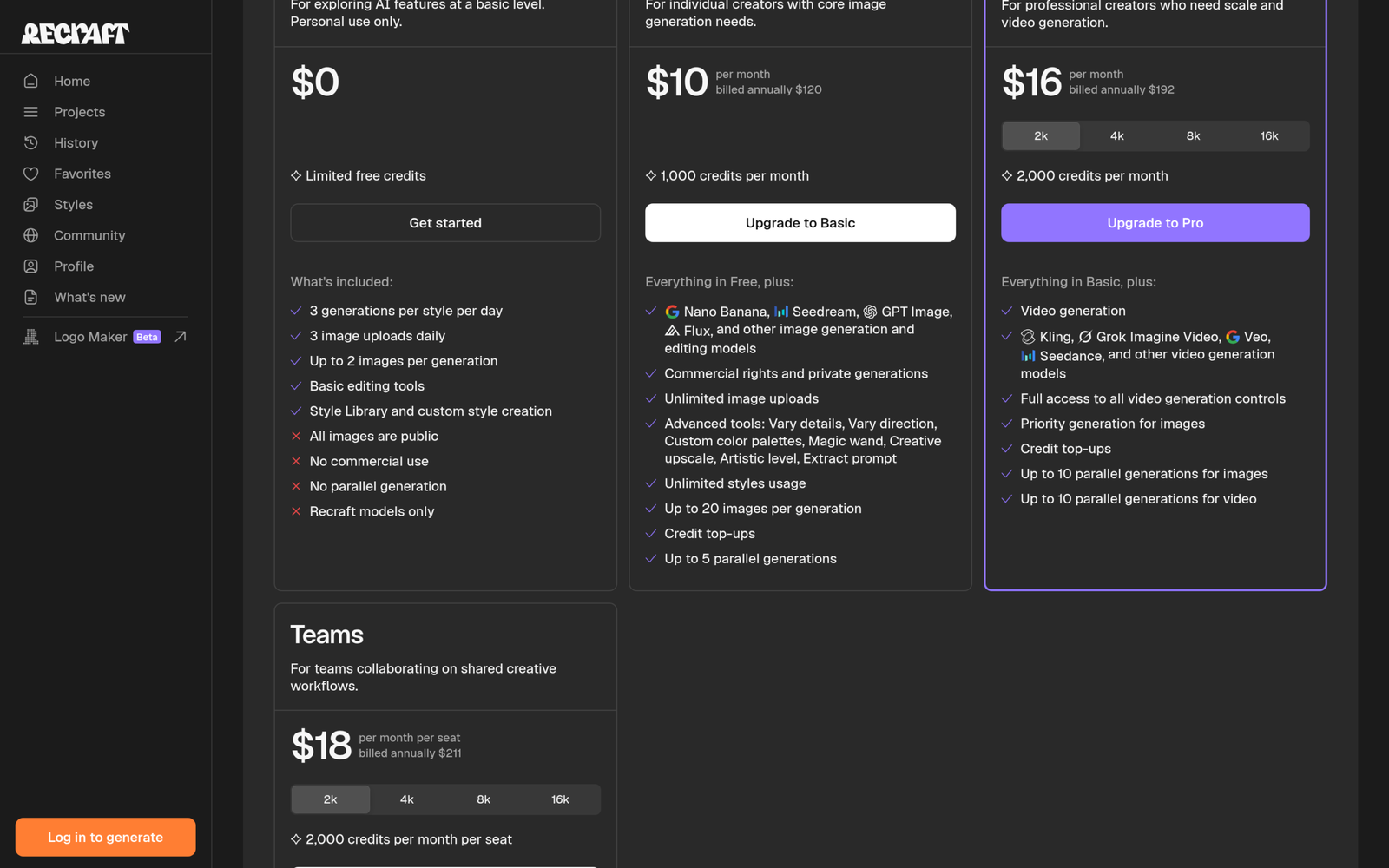
Read Recraft’s free tier legal fine print carefully before shipping client identity work. The $0 Free tier allocates 3 generations per style per day, makes generated assets publicly visible, and grants zero commercial ownership. Upgrading to $10/mo Basic billed annually (1,000 monthly credits) or $16/mo Pro annual (2,000 credits plus video tools) unlocks private workspaces and full commercial rights—while programmatic API generation runs straight from $0.035/image.
3.3Black Forest Labs FLUX (FLUX.2 Klein & Pro) — Best Photoreal Stills
For commercial photography lighting, accurate product text rendering, and natural skin micro-texture, Black Forest Labs’ FLUX family anchors the modern stack. Creators gain two clear tiers on docs.bfl.ml: open-weight FLUX.2 [klein] 4B ships under Apache 2.0 for completely free commercial local use on consumer GPUs (while larger FLUX.2 [dev] weights stay non-commercial unless separately licensed).
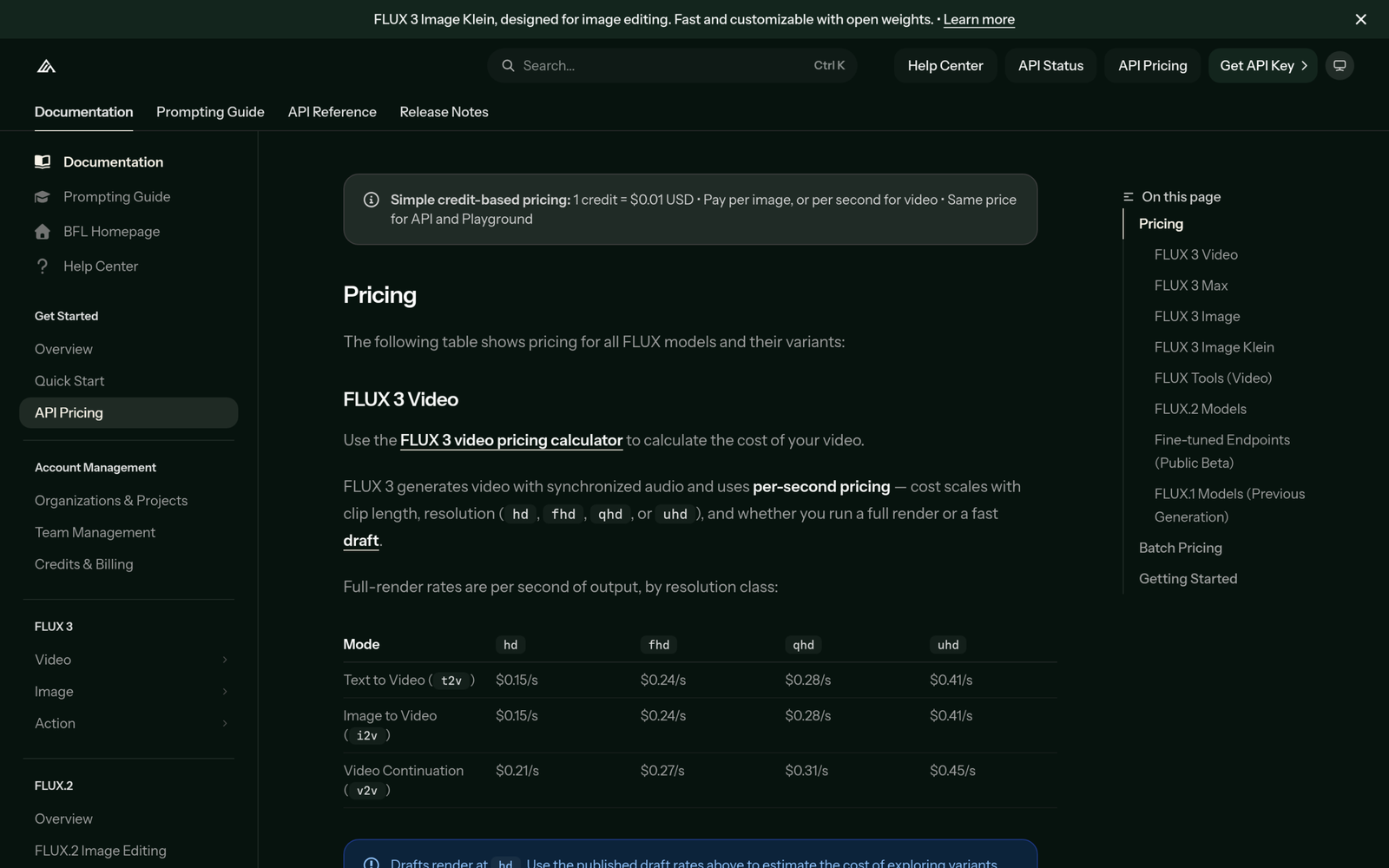
When hardware limits push work to the cloud, Black Forest Labs charges transparent penny-level credit billing (1 credit = $0.01): FLUX.2 [pro] renders 1MP photoreal frames for $0.03/MP ($0.045/MP edits), max runs $0.07/MP, and FLUX 3 Video runs $0.15–$0.45/s—all watermark-free with clean commercial ownership and zero forced public showcase feeds.
4.Side-by-Side Matrix: Free Tiers, Watermarks, Licensing, and Exports
Comparing headline “Free” buttons hides the exact license clauses that block paid client delivery. Many teams only spot public-gallery publication rules or non-commercial open-weight clauses after embedding draft renders inside pitch decks or live landing pages. Checking actual allowances, watermark policies, commercial rights, export formats, and developer endpoint pricing together prevents accidental license violations.
Notice also how export formats separate true production tools from locked web sandboxes. Vector .svg outputs from Recraft open cleanly inside Illustrator or Figma, Git-backed Remotion scenes compile straight to yuv420p .mp4 frames, and Apache 2.0 Wan 2.2 or FLUX.2 Klein pipelines export raw uncompressed PNG plates without injecting hidden tracking metadata.
| Alternative Stack | Free Allowance | Watermark Policy | Commercial License Rule | Key Exports & API Access |
|---|---|---|---|---|
| Wan 2.2 / Wan 3.0 | 100% unlimited local (Wan 2.2); 30s 90-day SG API trial |
Zero watermarks locally or via API | Apache 2.0 (Wan 2.2 weights); commercial API rights on Wan 3.0 |
MP4, PNG frames; local ComfyUI + Model Studio REST ($0.05–$0.20/s) |
| Pikzels | 3 free generations / 6 variants |
Paid tiers clean; free tier limited preview | Commercial thumbnail rights on active paid plans ($20–$80/mo) |
PNG/JPG creator aspect ratios; web studio UI (no public API) |
| Claude Code + Remotion | Free Remotion engine (<= 3 devs); Claude Code billed per API/Pro sub |
Zero watermarks | Full ownership of your React code & rendered MP4s (>3 devs need Remotion seat) |
MP4 (yuv420p), SVG, PNG sequences; local CLI / CI automation |
| Recraft V4 / V3 | 3 gens/style/day (Free) |
Zero watermarks (Paid), Free public only |
No commercial rights on Free; full ownership starts at $10/mo Basic annual |
Native SVG, PNG, Lottie/video tiers; API Units from $0.035/img |
FLUX (Klein / Pro) |
Unlimited local (FLUX.2 [klein] 4B); API prepaid ($0.01/cr) |
Zero watermarks | Apache 2.0 (Klein 4B); full commercial rights on FLUX.2 [pro] API ($0.03/MP) |
PNG, WebP, JPEG + MP4; local weights + BFL/partner APIs |
Notice the recurring structural takeaway across all five stacks above: genuine zero-dollar commercial ownership concentrates inside local open-weight software (Wan 2.2 Apache 2.0, FLUX.2 [klein] 4B, and Remotion for compact teams of three or fewer engineers). Hosted browser sandboxes almost universally require either an entry paid tier ($10/mo Recraft Basic, $20/mo Pikzels Essential) or pay-per-output API billing ($0.03/MP FLUX Pro, $0.05–$0.20/s Wan 3.0) before unlocking full private client ownership.
5.Building Zero-Watermark Creator Stacks Without Monthly Lock-In
Stacking five overlapping $30/mo creator subscriptions bleeds $150+/mo even during quiet production weeks, while half those credits expire unused every thirty days. Smart solo creators and compact agencies avoid multi-seat bloat by combining one free open-weight core locally with metered cloud APIs strictly where vector export or multi-speaker cloud scale saves real editing hours.
For a zero-fixed-monthly open stack, pair ComfyUI running Wan 2.2 TI2V-5B (motion B-roll) alongside FLUX.2 [klein] 4B (photoreal key frames) and Remotion (HUD cards, kinetic captions, SVG overlays). Everything renders locally or on cheap hourly RunPod instances cleanly inside Git repositories, keeping zero third-party watermarks and 100% IP ownership under Apache 2.0 and MIT tooling—leaving your cash strictly for studio voice synthesis or music stems.
For a lean $10–$30/mo agency hybrid, subscribe solely to Recraft Basic ($10/mo annual) whenever brand clients demand editable Illustrator-ready .svg icon systems, and buy $10 of prepaid Black Forest Labs API (1,000 credits = ~333 1MP FLUX.2 Pro product stills at $0.03 each) alongside Model Studio utility tokens ($0.20/s 1080p Wan 3.0). That whole modular studio stack regularly delivers stronger output diversity than any $69/mo bundled creative wrapper while dropping fixed idle spend close to zero during off-peak weeks.
When publishing on a tight YouTube weekly schedule, add Pikzels Essential ($20/mo) only during active channel growth sprints where persona-locked thumbnail CTR directly lifts sponsor revenue—and pause it immediately whenever editorial calendar production slows down.
6.Automation Check: Calling Open-Source and Pay-Per-Use APIs Cleanly
Leaving click-only dashboards behind pays massive dividends the first time a client requests twenty localized campaign graphics, multilingual vertical Reels, or five aspect-ratio test hooks for paid social. Instead of pasting prompts into browser forms twenty times and manually downloading ZIP archives, wrapping direct API endpoints inside a two-call shell or Python helper drops unwatermarked files straight into your campaign asset folder.
Direct endpoint billing also clarifies exact campaign unit costs for client invoicing. Rather than guessing how many ambiguous monthly “coins” a social shoot consumed, checking a live invoice from Black Forest Labs ($0.03 per megapixel on FLUX.2 Pro) and Alibaba Cloud Model Studio ($0.10/s at 720p on wan3.0-video) shows down to the penny how much raw media generation cost per finished reel.
Check how minimal an automated visual request looks when calling Black Forest Labs’ FLUX.2 [pro] beside Alibaba Model Studio’s wan3.0-video without LLM prompt rewriting:
# 1. Request a 1024x1024 FLUX.2 Pro commercial product still ($0.03)
curl -sS -X POST "https://api.bfl.ai/v1/flux-2-pro" \
  -H "x-key: $BFL_API_KEY" \
  -H "Content-Type: application/json" \
  -d '{"prompt":"Matte anodized aluminum studio microphone on slate desk, soft key light","width":1024,"height":1024}'

# 2. Request a 5-second 720p Wan 3.0 B-roll clip ($0.50 total) without LLM prompt rewriting
curl -sS -X POST "https://dashscope-intl.aliyuncs.com/api/v1/services/aigc/video-generation/video-synthesis" \
  -H "Authorization: Bearer $DASHSCOPE_API_KEY" \
  -H "Content-Type: application/json" \
  -d '{"model":"wan3.0-video","input":{"prompt":"Slow dolly in around studio microphone, subtle dust in warm key beam"},"parameters":{"resolution":"720P","duration":5,"prompt_extend":false}}'
Always enforce three operational safeguards before scheduling recurring image or video generation inside scripts. Keep API keys strictly in local environment files outside your repository root (~/.artimind/), pin explicit resolution and duration strings so a missing parameter never triggers an unrequested 1080p max-length job, and verify every returned asset’s HTTP status (200) and file bytes cleanly before moving downstream into Remotion video compositions.
7.Commercial Rights, API Access, and Frequently Asked Questions
Before canceling old creative bundles, verify three compliance checkpoints across your replacement stack: keep proof of open-weight Apache 2.0 (Wan 2.2 / FLUX.2 Klein) or active paid seat receipts alongside client project folders, verify that free-tier Recraft experiments never cross into commercial client deliverables, and pin explicit resolution caps in API payloads so test batches never run unchecked overnight.
7.1Can you use Recraft’s free $0 plan for commercial client work or merch?
No. Recraft explicitly restricts its Free tier (3 generations per style per day) to non-commercial exploration, and every image created on Free appears in public feeds. Moving to Basic ($10/mo annual) or purchasing metered API Units grants private generations and full commercial rights.
7.2Which FLUX model is genuinely free for commercial self-hosting?
Pick FLUX.2 [klein] 4B, which Black Forest Labs ships under an open Apache 2.0 license permitting free commercial weights deployment on local hardware. By contrast, FLUX.2 [dev] open weights stay restricted to non-commercial testing unless separately licensed—or you can call hosted FLUX.2 [pro] API endpoints from $0.03/MP for full commercial ownership.
7.3Is CreativeGenius AI still a bundled text-to-image generator in 2026?
Not under its primary creativegenius.ai domain, which currently serves as an AI software engineering and automation consultancy (Creative Genius LLC). Creators hunting self-serve image, thumbnail, vector, and video generation workflows are better served assembling specialist tools like Wan 2.2, FLUX, Recraft, and Remotion.
7.4How many developers can use Remotion free for motion graphics videos?
Individuals and small organizations with three or fewer developers (<= 3) can run Remotion locally and in CI at $0 license cost while keeping full rights to rendered videos. Once an organization reaches four or more engineers, Remotion requires commercial company licensing.
7.5What hardware minimum runs Wan 2.2 free locally without API billing?
Wan’s compact TI2V-5B model runs comfortably on 8 GB VRAM GPUs with ComfyUI weight offloading at 720p @ 24 fps, while the dual-expert A14B models run on 24 GB GPUs (RTX 3090 / 4090) using fp8_scaled or QuantStack GGUF Q4_K_M checkpoints.


One Comment